Switzerland Sleep Apnea Devices Market Size and Insights – 2026 to 2033
Report ID : IL_5732 | Report Language's : En/Jp/Fr/De | Publisher : IL |
Format : 


What is the Market Size of the Switzerland Sleep Apnea Devices in 2026?
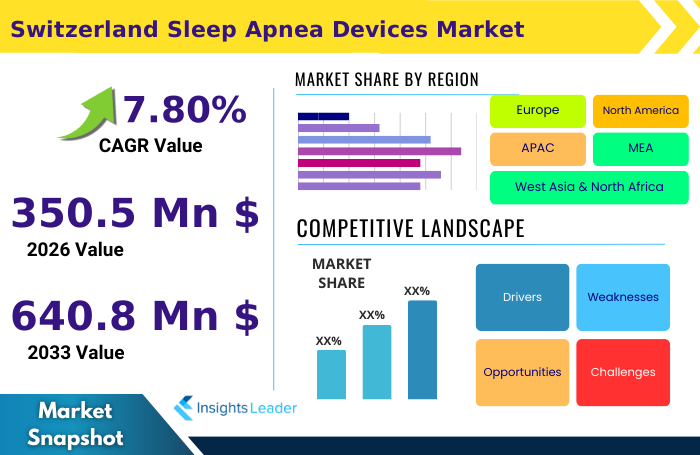
The Switzerland Sleep Apnea Devices Market Size in 2026 is estimated to be USD 350.5 Million
What is the Growth Rate (CAGR) of Switzerland Sleep Apnea Devices Market?
The Switzerland Sleep Apnea Devices Market is expected to grow at 7.8% CAGR
What is the Market Size of the Switzerland Sleep Apnea Devices in 2033?
The Switzerland Sleep Apnea Devices Market Size in 2033 is estimated to be USD 640.8 Million
What are DRO and Impact Forces of Switzerland Sleep Apnea Devices Market?
DRO stands for Drivers, Restraints, and Opportunities, which are fundamental analytical components used to assess market trajectory and potential. Drivers are factors stimulating market expansion (e.g., prevalence of chronic sleep disorders), while Restraints impede growth (e.g., high device costs). Opportunities represent promising untapped segments like home sleep testing. Impact Forces quantify the influence of external, macro-environmental variables—such as regulatory shifts, economic policies, or trade disruptions—on the overall market dynamics and competitive landscape.
What is Impact of U.S. Tariffs on Switzerland Sleep Apnea Devices Market?
While Switzerland maintains distinct trade agreements, US tariffs indirectly impact the global medical device supply chain, particularly for specialized electronic components sourced from regions subject to these duties. This often results in increased raw material and operational costs for multinational manufacturers supplying the Swiss market, potentially leading to higher device prices for end-users and healthcare providers. Consequently, Swiss distributors may face pressure on inventory costs and profitability, necessitating diversified sourcing strategies.
How is AI currently impacting Switzerland Sleep Apnea Devices Market?
Artificial Intelligence (AI) is transforming industries globally by enhancing predictive analytics, optimizing complex operational workflows, and accelerating personalized innovation. In the medical technology sector, AI is crucial for improving diagnostic efficiency through automated scoring of sleep studies, refining treatment efficacy by personalizing CPAP pressure settings, and enabling advanced remote patient monitoring systems. Globally, AI adoption reduces diagnostic time-to-treatment and fosters sophisticated, data-driven decision-making across clinical and research settings.