Asia-Pacific Occupant Classification System Market Size and Insights – 2026 to 2033
Report ID : IL_15785 | Report Language's : En/Jp/Fr/De | Publisher : IL |
Format : 



What is the Market Size of the Asia-Pacific Occupant Classification System in 2026?
The Asia-Pacific Occupant Classification System Market Size in 2026 is estimated to be USD 1.31 Billion
What is the Growth Rate (CAGR) of Asia-Pacific Occupant Classification System Market?
The Asia-Pacific Occupant Classification System Market is expected to grow at 9.5% CAGR
What is the Market Size of the Asia-Pacific Occupant Classification System in 2033?
The Asia-Pacific Occupant Classification System Market Size in 2033 is estimated to be USD 2.45 Billion
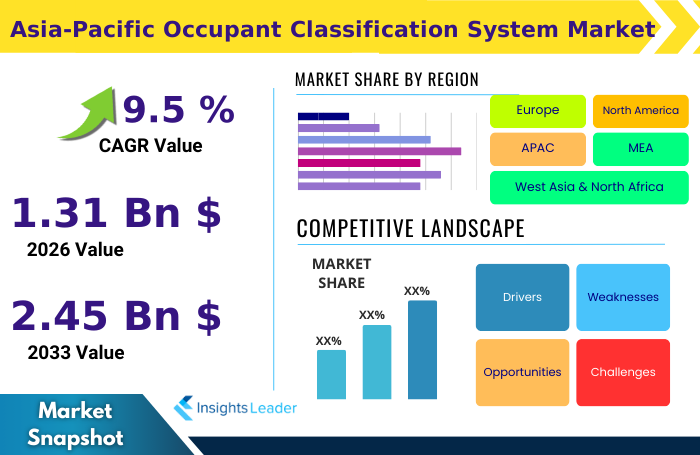
Report Snapshot
| Report Attributes | Report Details |
|---|---|
| Forecast Year | 2033 |
| CAGR | 9.5% |
| History Year | 2016-2024 |
| Market Size in 2026 | 1.31 Billion USD |
| Market Size in 2033 | 2.45 Billion USD |
What are DRO & Impact Forces of Asia-Pacific Occupant Classification System Market?
Drivers: Stringent government regulations mandating advanced safety features (e.g., improved NCAP ratings) and increasing consumer demand for vehicular safety. Restraints: High integration costs and complexity associated with multi-sensor OCS technology, particularly for entry-level vehicle segments in developing APAC nations. Opportunities: Integration of OCS with Autonomous Driving Systems (ADAS) and increased adoption of pressure-based sensing technologies in electric vehicles.
What is Impact of US Tariffs on Asia-Pacific Occupant Classification System Market?
The direct impact of U.S. tariffs on the Asia-Pacific OCS market is generally contained due to regionalized supply chains, especially in China, Japan, and South Korea, which serve as major production hubs. However, indirect effects manifest through volatility in global semiconductor and raw material prices, potentially increasing manufacturing costs for Tier 1 suppliers operating within the APAC region. These tariffs also influence the global automotive production landscape, which can moderately affect component demand in export-focused APAC economies.
How is AI currently impacting Asia-Pacific Occupant Classification System Market?
AI significantly impacts OCS by enabling sophisticated sensor fusion algorithms that process data from multiple sources (pressure, vision, infrared). This enhances the accuracy of distinguishing between adult occupants, children, and inanimate objects, improving restraint system deployment decisions. Machine learning models are crucial for predicting occupant posture and vulnerability during pre-crash scenarios, leading to more personalized and safer airbag activation timings.
Asia-Pacific Occupant Classification System Market Research Report – Table of Contents
1. Executive Summary
2. Introduction & Research Objectives
3. Scope of the Study
4. Research Methodology of Asia-Pacific Occupant Classification System Market
5. Asia-Pacific Occupant Classification System Market Overview & Industry Background
6. Asia-Pacific Occupant Classification System Market Size & Forecast Analysis
7. Asia-Pacific Occupant Classification System Market Segmentation Analysis
8. Competitive Landscape
9. Consumer Behavior & Demand Analysis
10. Pricing & Cost Structure Analysis
11. Asia-Pacific Occupant Classification System Market Drivers, Challenges & Risks
12. Regulatory & Policy Framework
13. Technology & Innovation Impact
14. Strategic Insights & Recommendations
15. Conclusion & Future Outlook
For more queries, kindly contact [email protected]