Indonesia Carbon Credits Market Size and Insights – 2026 to 2033
Report ID : IL_6386 | Report Language's : En/Jp/Fr/De | Publisher : IL |
Format : 


What is the Market Size of the Indonesia Carbon Credits in 2026?
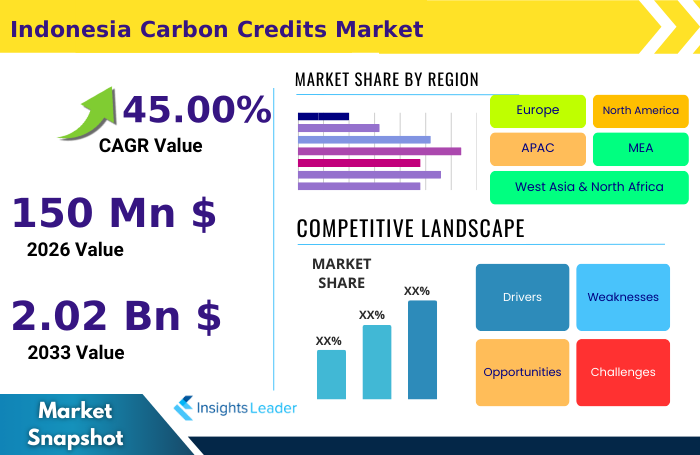
The Indonesia Carbon Credits Market Size in 2026 is estimated to be $150 Million
What is the Growth Rate (CAGR) of Indonesia Carbon Credits Market?
The Indonesia Carbon Credits Market is expected to grow at CAGR 45.0%
What is the Market Size of the Indonesia Carbon Credits in 2033?
The Indonesia Carbon Credits Market Size in 2033 is estimated to be $2.02 Billion
What are DRO and Impact Forces of Indonesia Carbon Credits Market?
Drivers include strong government commitment to Net Zero (NDC targets), vast natural resources suitable for nature-based solutions (REDD+), and surging voluntary market demand from multinational corporations seeking offsets.Restraints involve significant regulatory uncertainty, especially concerning benefit-sharing and permitting, alongside complexities in land tenure and potential project reversal risks due to illegal logging or land-use changes.Opportunities lie in developing Article 6 compliant bilateral agreements and enhancing transparency via digital registry systems.
What is Impact of U.S. Tariffs on Indonesia Carbon Credits Market?
The direct impact of standard US trade tariffs on carbon credit transactions is negligible, as carbon credits are financial instruments rather than physical goods subject to import duties.However, indirect impacts arise from US tariffs affecting goods manufactured by major industrial buyers in Indonesia, potentially slowing the expansion of US-affiliated corporate operations and reducing the overall local demand for voluntary offsets.Furthermore, US climate policy and corporate reporting requirements (e.g., SEC climate rules) significantly influence the cross-border voluntary market demand, driving international investment into high-quality Indonesian projects.
How is AI currently impacting Indonesia Carbon Credits Market?
Artificial Intelligence (AI) is globally impacting industries by revolutionizing operational efficiency through predictive analytics, automating complex data processing tasks, and optimizing supply chains. In the carbon market specifically, AI enhances the Monitoring, Reporting, and Verification (MRV) process by analyzing satellite imagery and sensor data to accurately quantify carbon sequestration and detect deforestation in near real-time, thereby increasing project credibility and scalability.