North America PVC Compound Market Size and Insights – 2026 to 2033
Report ID : IL_6119 | Report Language's : En/Jp/Fr/De | Publisher : IL |
Format : 


What is the Market Size of the North America PVC Compound in 2026?
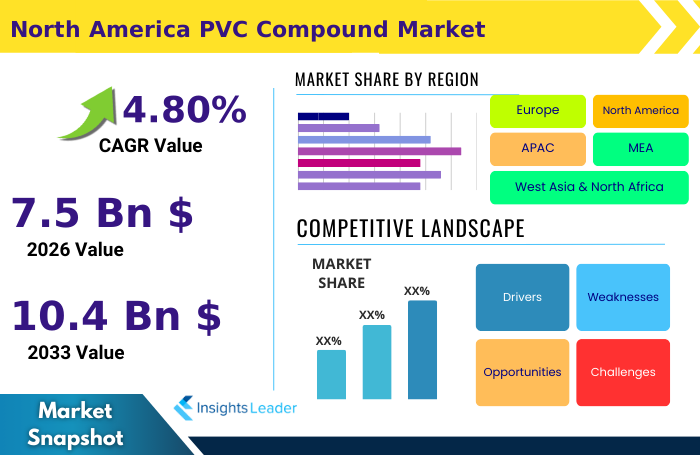
The North America PVC Compound Market Size in 2026 is estimated to be $7.5 Billion
What is the Growth Rate (CAGR) of North America PVC Compound Market?
The North America PVC Compound Market is expected to grow at 4.8% CAGR
What is the Market Size of the North America PVC Compound in 2033?
The North America PVC Compound Market Size in 2033 is estimated to be $10.4 Billion
What are DRO and Impact Forces of North America PVC Compound Market?
DRO (Drivers, Restraints, Opportunities) and Impact Forces define the macro and micro environmental factors shaping market evolution. Drivers include robust construction sector demand and versatility of PVC in diverse applications. Restraints involve stringent environmental regulations regarding phthalates and competition from bio-based alternatives. Opportunities lie in developing specialized, high-performance, lead-free PVC formulations, particularly for medical and electric vehicle (EV) applications.
What is Impact of U.S. Tariffs on North America PVC Compound Market?
US tariffs, primarily imposed on goods imported from key manufacturing regions, increase the cost of imported raw materials and finished PVC products, shifting manufacturing focus domestically. While domestic producers gain a competitive advantage on price, tariffs introduce supply chain volatility and inflationary pressures on end-user industries such as construction and automotive. This can stimulate nearshoring or reshoring of compounding operations but increases capital expenditure risks.
How is AI currently impacting North America PVC Compound Market?
AI is currently optimizing global industrial processes through predictive maintenance, supply chain management, and advanced material science research. In the PVC compound industry specifically, AI algorithms are being used to fine-tune compound formulations for desired properties (e.g., heat stability, flexibility) with minimized material waste, enhancing operational efficiency and accelerating new product development cycles across the manufacturing value chain.