Asia-Pacific Automotive Chip Market Size and Insights – 2026 to 2033
Report ID : IL_15801 | Report Language's : En/Jp/Fr/De | Publisher : IL |
Format : 


What is the Market Size of the Asia-Pacific Automotive Chip in 2026?
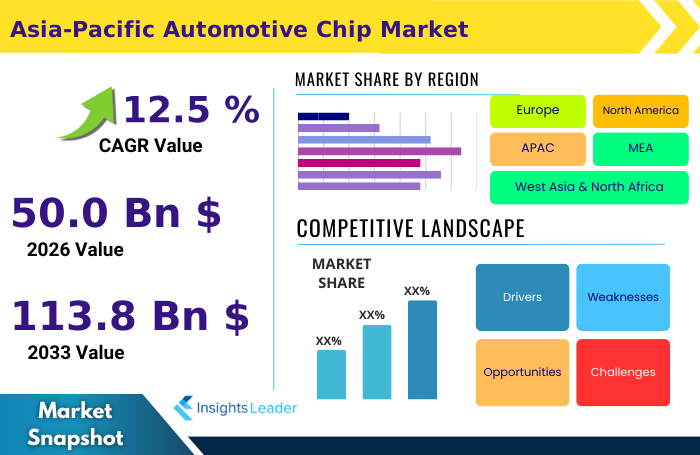
The Asia-Pacific Automotive Chip Market Size in 2026 is estimated to be $50.0 Billion
What is the Growth Rate (CAGR) of Asia-Pacific Automotive Chip Market?
The Asia-Pacific Automotive Chip Market is expected to grow at 12.5% CAGR
What is the Market Size of the Asia-Pacific Automotive Chip in 2033?
The Asia-Pacific Automotive Chip Market Size in 2033 is estimated to be $113.8 Billion
Report Snapshot
| Report Attributes | Report Details |
|---|---|
| Forecast Year | 2033 |
| CAGR | 12.5% |
| History Year | 2016-2024 |
| Market Size in 2026 | 50.0 Billion USD |
| Market Size in 2033 | 113.8 Billion USD |
What are DRO & Impact Forces of Asia-Pacific Automotive Chip Market?
Drivers (D) include rapid adoption of Electric Vehicles (EVs) and advanced driver-assistance systems (ADAS), increasing semiconductor content per vehicle. Restraints (R) involve persistent supply chain volatility and high capital expenditure required for establishing advanced fabrication facilities. Opportunities (O) arise from government incentives promoting domestic chip manufacturing and the shift towards zonal electronic architectures. Impact Forces are primarily driven by technological convergence and geopolitical competition for semiconductor dominance.
What is Impact of US Tariffs on Asia-Pacific Automotive Chip Market?
U.S. tariffs primarily increase the cost of semiconductor components and finished chips manufactured in targeted APAC regions, particularly China, destined for global supply chains. This pressure accelerates efforts towards supply chain diversification and regional localization within the APAC bloc, seeking to mitigate geopolitical risks. While tariffs introduce short-term price instability and logistics complexities, they incentivize long-term self-sufficiency in materials and fabrication technology across the region.
How is AI currently impacting Asia-Pacific Automotive Chip Market?
Artificial Intelligence (AI) serves as a fundamental driver for next-generation automotive chips, necessitating high-performance System-on-Chips (SoCs) and specialized accelerators for autonomous driving functions and complex sensor fusion. AI algorithms optimize vehicle performance, enhance passenger experience through sophisticated infotainment, and improve manufacturing yield and predictive maintenance for both chip producers and automotive OEMs. This necessitates continuous investment in advanced process nodes suitable for AI processing power.
Asia-Pacific Automotive Chip Market Research Report – Table of Contents
1. Executive Summary
2. Introduction & Research Objectives
3. Scope of the Study
4. Research Methodology of Asia-Pacific Automotive Chip Market
5. Asia-Pacific Automotive Chip Market Overview & Industry Background
6. Asia-Pacific Automotive Chip Market Size & Forecast Analysis
7. Asia-Pacific Automotive Chip Market Segmentation Analysis
8. Competitive Landscape
9. Consumer Behavior & Demand Analysis
10. Pricing & Cost Structure Analysis
11. Asia-Pacific Automotive Chip Market Drivers, Challenges & Risks
12. Regulatory & Policy Framework
13. Technology & Innovation Impact
14. Strategic Insights & Recommendations
15. Conclusion & Future Outlook
For more queries, kindly contact [email protected]