Asia-Pacific Breast Biopsy Devices Market Size and Insights – 2026 to 2033
Report ID : IL_6774 | Report Language's : En/Jp/Fr/De | Publisher : IL |
Format : 


What is the Market Size of the Asia-Pacific Breast Biopsy Devices in 2026?
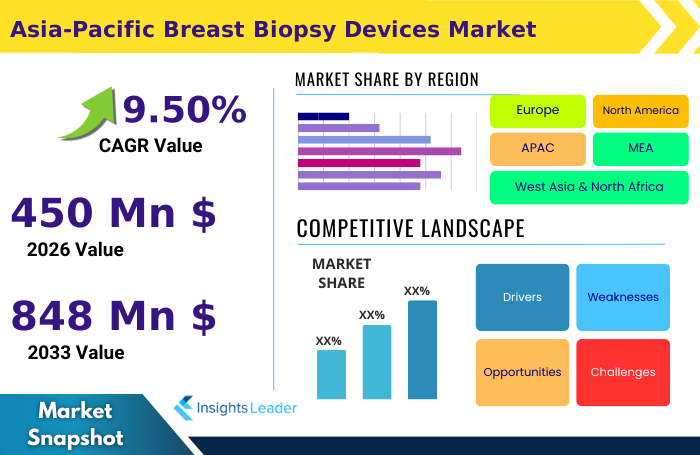
The Asia-Pacific Breast Biopsy Devices Market Size in 2026 is estimated to be $450 Million USD
What is the Growth Rate (CAGR) of Asia-Pacific Breast Biopsy Devices Market?
The Asia-Pacific Breast Biopsy Devices Market is expected to grow at 9.5% CAGR
What is the Market Size of the Asia-Pacific Breast Biopsy Devices in 2033?
The Asia-Pacific Breast Biopsy Devices Market Size in 2033 is estimated to be $848 Million USD
What are DRO and Impact Forces of Asia-Pacific Breast Biopsy Devices Market?
Drivers (D) include the rising prevalence of breast cancer across APAC, increased screening programs, and the shift towards minimally invasive procedures like Vacuum-Assisted Biopsy (VAB). Restraints (R) involve high procedure costs in emerging economies and limited infrastructure access in rural areas. Opportunities (O) are centered around technological advancements such as robot-assisted biopsy systems and localized manufacturing initiatives.
What is Impact of U.S. Tariffs on Asia-Pacific Breast Biopsy Devices Market?
The impact of US tariffs primarily affects supply chain stability and pricing for advanced biopsy equipment imported from the US and certain allied nations into the APAC region. While direct tariffs may not be universal, they contribute to global trade volatility, potentially leading to increased procurement costs for high-precision diagnostic imaging and core biopsy systems, thereby slowing technology adoption in cost-sensitive markets.
How is AI currently impacting Asia-Pacific Breast Biopsy Devices Market?
Artificial Intelligence is revolutionizing global industries by enhancing data analysis, automating complex processes, and facilitating personalized solutions. In healthcare, specifically, AI is crucial for improving image recognition accuracy in diagnostics (such as mammography and pathology slides), optimizing operational efficiencies in hospitals, and accelerating drug discovery and treatment planning, leading to more precise and timely patient interventions.