Canada Vertical Farming Market Size and Insights – 2026 to 2033
Report ID : IL_6632 | Report Language's : En/Jp/Fr/De | Publisher : IL |
Format : 


What is the Market Size of the Canada Vertical Farming in 2026?
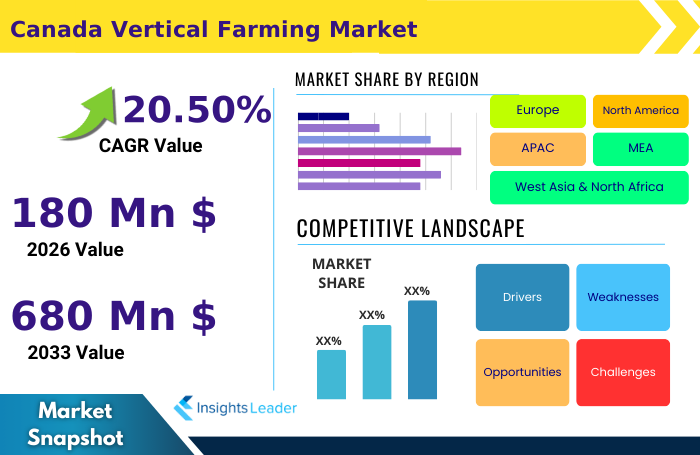
The Canada Vertical Farming Market Size in 2026 is estimated to be USD 180 Million
What is the Growth Rate (CAGR) of Canada Vertical Farming Market?
The Canada Vertical Farming Market is expected to grow at 20.5% CAGR
What is the Market Size of the Canada Vertical Farming in 2033?
The Canada Vertical Farming Market Size in 2033 is estimated to be USD 680 Million
What are DRO and Impact Forces of Canada Vertical Farming Market?
DRO stands for Drivers, Restraints, and Opportunities, which collectively represent the structural forces shaping market dynamics. Drivers include the need for food security and year-round local production in harsh climates, while Restraints center on high initial capital expenditure and energy consumption costs. Opportunities involve technological advancements in LED lighting and automation, coupled with increasing government focus on sustainable agriculture solutions, particularly in urban environments.
What is Impact of U.S. Tariffs on Canada Vertical Farming Market?
The direct impact of general US tariffs on the Canadian vertical farming sector is relatively contained regarding produce movement, as Canadian vertical farms primarily serve local domestic markets. However, specific tariffs or trade barriers related to importing high-tech components, such as specialized sensors, LED lights, and advanced climate control systems, originating from global manufacturing hubs and transiting via the US, can increase the operational expenditure (OPEX) and capital expenditure (CAPEX) for Canadian operators, potentially slowing expansion rates.
How is AI currently impacting Canada Vertical Farming Market?
Artificial Intelligence (AI) is fundamentally transforming industries globally by enhancing efficiency, enabling predictive analytics, and automating complex processes. Key impacts include optimizing supply chains through real-time demand forecasting, improving personalized customer experiences via sophisticated data modeling, and accelerating research and development cycles. In manufacturing and agriculture (including vertical farming), AI controls climate parameters, diagnoses plant diseases, and manages energy use autonomously, leading to significant productivity gains and resource conservation.