China Vertical Farming Market Size and Insights – 2026 to 2033
Report ID : IL_6592 | Report Language's : En/Jp/Fr/De | Publisher : IL |
Format : 


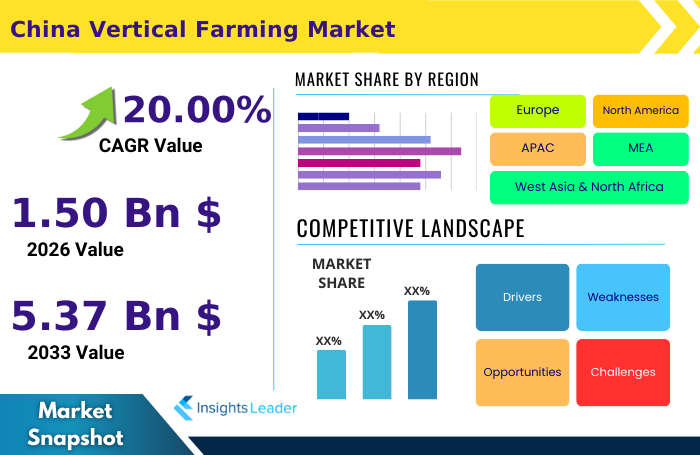
What is the Market Size of the China Vertical Farming in 2026?
The China Vertical Farming Market Size in 2026 is estimated to be USD 1.50 Billion
What is the Growth Rate (CAGR) of China Vertical Farming Market?
The China Vertical Farming Market is expected to grow at CAGR 20.0%
What is the Market Size of the China Vertical Farming in 2033?
The China Vertical Farming Market Size in 2033 is estimated to be USD 5.37 Billion
What are DRO and Impact Forces of China Vertical Farming Market?
Drivers include accelerated urbanization, pressing food security concerns, and substantial governmental promotion of advanced agricultural technologies. Restraints involve the high initial capital expenditure required for facility construction and elevated operational energy costs. Opportunities lie in expanding cultivation to high-value medicinal crops and integrating sophisticated Internet of Things (IoT) systems for optimized resource management.
What is Impact of U.S. Tariffs on China Vertical Farming Market?
US tariffs primarily impact the cost of essential imported high-tech components, such as advanced LED lighting systems and complex sensors, which are vital for vertical farming operations. This increased import cost elevates the overall capital expenditure for Chinese vertical farm operators. Concurrently, these tariffs act as a catalyst, encouraging rapid domestic research and development and fostering localization in the supply chain for advanced agri-tech equipment within China.
How is AI currently impacting China Vertical Farming Market?
Globally, Artificial Intelligence (AI) fundamentally transforms industrial operations by enabling predictive maintenance, optimizing complex logistical supply chains, and facilitating hyper-personalized customer engagement strategies. In the agricultural sector, AI drives critical improvements through automated resource allocation (water and nutrients), real-time environmental climate control, and highly accurate yield forecasting, thereby enhancing efficiency and minimizing environmental impact across the value chain.