Singapore Contact Lenses Market Size and Insights – 2026 to 2033
Report ID : IL_5933 | Report Language's : En/Jp/Fr/De | Publisher : IL |
Format : 


What is the Market Size of the Singapore Contact Lenses in 2026?
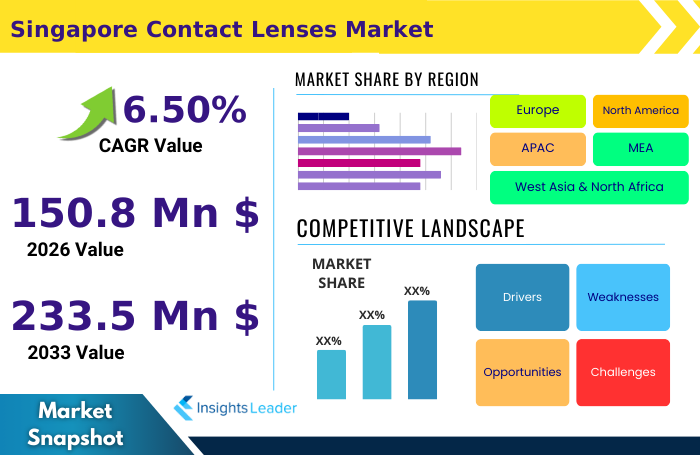
The Singapore Contact Lenses Market Size in 2026 is estimated to be USD 150.8 Million
What is the Growth Rate (CAGR) of Singapore Contact Lenses Market?
The Singapore Contact Lenses Market is expected to grow at CAGR 6.5%
What is the Market Size of the Singapore Contact Lenses in 2033?
The Singapore Contact Lenses Market Size in 2033 is estimated to be USD 233.5 Million
What are DRO and Impact Forces of Singapore Contact Lenses Market?
DRO (Driving, Restraining, and Opportunity) Forces are strategic market analysis components used to determine the trajectory and potential impediments within a specific industry. They provide a foundational structure for forecasting market evolution. Impact Forces, conversely, refer to external, often sudden events (like pandemics, regulatory shifts, or major technological breakthroughs) that exert immediate, non-linear pressure on market dynamics and supply chains, necessitating adaptive business strategies.
What is Impact of U.S. Tariffs on Singapore Contact Lenses Market?
The impact of US tariffs, particularly those related to trade disputes with major Asian manufacturing hubs, affects the contact lens market primarily through increased import costs for raw materials, manufacturing equipment, and finished goods exported to the US. While Singapore itself is a key distribution hub, rising global trade protectionism can lead to supply chain diversification away from high-tariff regions, potentially raising operational costs or shifting manufacturing base locations, ultimately affecting consumer pricing and regional competitiveness.
How is AI currently impacting Singapore Contact Lenses Market?
Artificial Intelligence (AI) is globally impacting industries by automating complex processes, enhancing predictive analytics, and optimizing supply chain efficiencies. In healthcare, including the vision care sector, AI is crucial for diagnostics, personalized treatment planning, and optimizing retail customer experience through virtual try-ons and sophisticated inventory management. This integration drives higher productivity and necessitates significant digital transformation investments across sectors.