Asia-Pacific Dinnerware Market Size and Insights – 2026 to 2033
Report ID : IL_6787 | Report Language's : En/Jp/Fr/De | Publisher : IL |
Format : 


What is the Market Size of the Asia-Pacific Dinnerware in 2026?
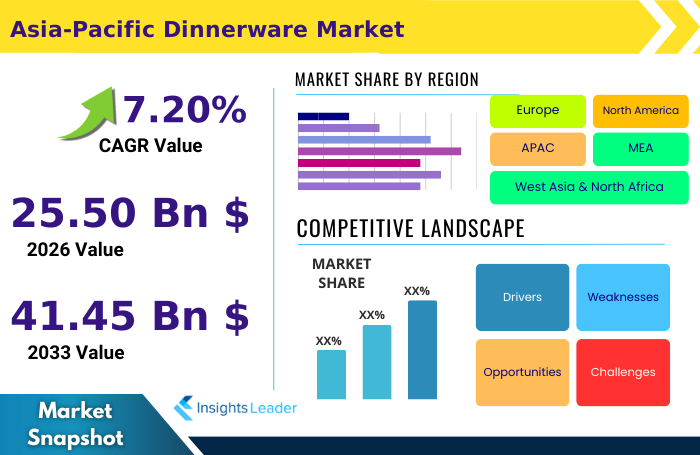
The Asia-Pacific Dinnerware Market Size in 2026 is estimated to be USD 25.50 Billion
What is the Growth Rate (CAGR) of Asia-Pacific Dinnerware Market?
The Asia-Pacific Dinnerware Market is expected to grow at CAGR 7.2%
What is the Market Size of the Asia-Pacific Dinnerware in 2033?
The Asia-Pacific Dinnerware Market Size in 2033 is estimated to be USD 41.45 Billion
What are DRO and Impact Forces of Asia-Pacific Dinnerware Market?
Drivers, Restraints, and Opportunities (DRO) are the core analytical components that define the trajectory and structure of the market. Drivers are positive factors sustaining growth (e.g., urbanization, rising disposable income), while Restraints are inhibiting factors (e.g., supply chain volatility, high raw material costs). Opportunities represent potential expansion avenues (e.g., e-commerce adoption, premiumization). Impact Forces are the collective resultant effects of these DRO components on competitive dynamics and industry viability over the specific forecast period, influencing strategic decision-making.
What is Impact of U.S. Tariffs on Asia-Pacific Dinnerware Market?
The ongoing US tariffs, particularly those targeting goods from major Asia-Pacific manufacturing nations like China, impose significant cost pressures and supply chain volatility on regional dinnerware producers. These tariffs raise the cost of export goods, often requiring manufacturers to adjust sourcing or distribution strategies, leading to increased interest in diversified production bases across countries like Vietnam and India. While affecting global trade flows, the tariffs minimally impact localized domestic APAC demand, but they do shift foreign investment and manufacturing capacity within the region.
How is AI currently impacting Asia-Pacific Dinnerware Market?
AI is fundamentally reshaping global industries through the application of advanced predictive analytics, process automation, and optimization of complex supply chains. In manufacturing sectors relevant to dinnerware, AI enhances quality control, optimizes resource usage, and facilitates highly accurate demand forecasting, reducing waste and improving inventory management. Furthermore, AI-driven personalization and algorithmic retailing are transforming consumer engagement and driving sales efficiency across global e-commerce platforms, offering faster, data-informed responses to market shifts.