Asia-Pacific Electrodeposited Copper Foils Market Size and Insights – 2026 to 2033
Report ID : IL_6796 | Report Language's : En/Jp/Fr/De | Publisher : IL |
Format : 


What is the Market Size of the Asia-Pacific Electrodeposited Copper Foils in 2026?
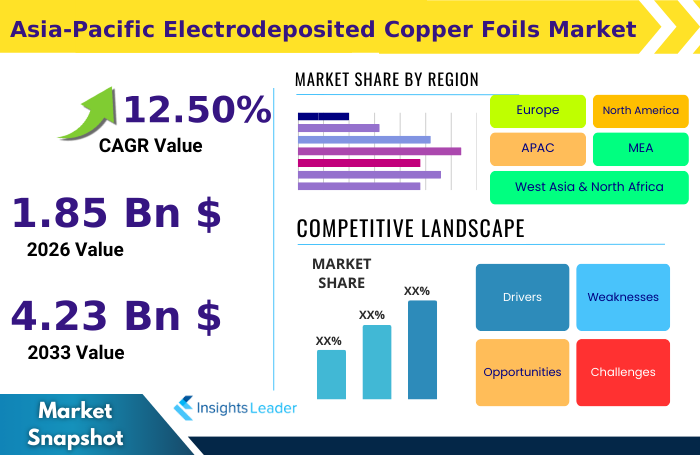
The Asia-Pacific Electrodeposited Copper Foils Market Size in 2026 is estimated to be $1.85 Billion USD
What is the Growth Rate (CAGR) of Asia-Pacific Electrodeposited Copper Foils Market?
The Asia-Pacific Electrodeposited Copper Foils Market is expected to grow at 12.5% CAGR
What is the Market Size of the Asia-Pacific Electrodeposited Copper Foils in 2033?
The Asia-Pacific Electrodeposited Copper Foils Market Size in 2033 is estimated to be $4.23 Billion USD
What are DRO and Impact Forces of Asia-Pacific Electrodeposited Copper Foils Market?
DRO stands for Drivers, Restraints, and Opportunities, the fundamental forces that shape market dynamics. Drivers (D) are factors accelerating growth, such as electric vehicle adoption. Restraints (R) are limiting factors, like volatility in raw material prices. Opportunities (O) refer to potential areas for new growth, such as the development of ultra-thin, high-performance foils.
What is Impact of U.S. Tariffs on Asia-Pacific Electrodeposited Copper Foils Market?
US tariffs on goods originating primarily from major APAC manufacturing hubs introduce significant cost instability and supply chain risks for end-users globally. These tariffs incentivize strategic sourcing diversification away from taxed regions, benefiting alternative suppliers in Southeast Asia and enhancing regional trade complexity. The ultimate impact includes higher component costs and pressure on producers to absorb margin losses or relocate operations.
How is AI currently impacting Asia-Pacific Electrodeposited Copper Foils Market?
AI is fundamentally reshaping industrial operations by implementing predictive maintenance protocols, significantly reducing unplanned downtime, and optimizing complex global supply chain logistics. Furthermore, AI tools are accelerating product innovation cycles and improving the precision of quality control in high-tech manufacturing, thereby enhancing overall efficiency and enabling highly customized consumer interaction models across various sectors.