Canada Dyes And Pigments Market Size and Insights – 2026 to 2033
Report ID : IL_6644 | Report Language's : En/Jp/Fr/De | Publisher : IL |
Format : 


What is the Market Size of the Canada Dyes And Pigments in 2026?
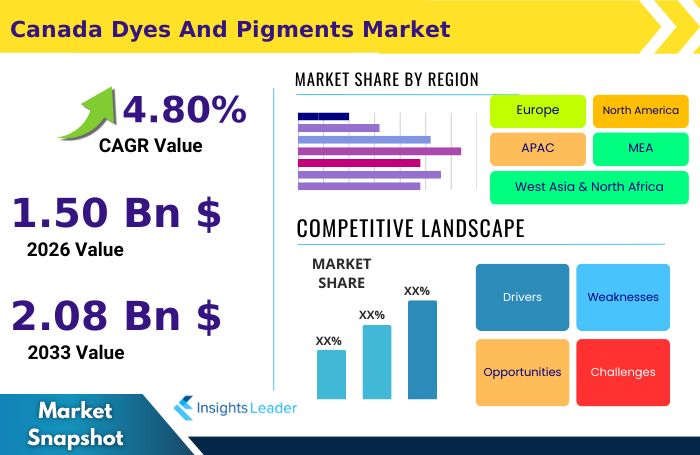
The Canada Dyes And Pigments Market Size in 2026 is estimated to be USD 1.50 Billion
What is the Growth Rate (CAGR) of Canada Dyes And Pigments Market?
The Canada Dyes And Pigments Market is expected to grow at 4.8% CAGR
What is the Market Size of the Canada Dyes And Pigments in 2033?
The Canada Dyes And Pigments Market Size in 2033 is estimated to be USD 2.08 Billion
What are DRO and Impact Forces of Canada Dyes And Pigments Market?
DRO (Drivers, Restraints, Opportunities) define the internal dynamics of the market, such as demand from the textile or construction industries (Drivers) and stringent environmental regulations (Restraints).Impact Forces are external, large-scale factors, including geopolitical stability, macroeconomic shifts, and technological disruptions, that significantly alter market trajectory beyond standard competitive factors.These forces collectively dictate investment patterns, supply chain resilience, and the long-term feasibility of new product introduction within the Canadian market.
What is Impact of U.S. Tariffs on Canada Dyes And Pigments Market?
US tariffs, particularly those targeting chemical imports from major global producers, lead to significant recalibration of Canadian procurement strategies for raw dye and pigment materials.This often results in increased landed costs for intermediate chemicals, elevating manufacturing expenses for Canadian end-users in sectors like printing inks, plastics, and coatings.The resulting trade disruption compels Canadian companies to diversify supply chains, often sourcing from non-tariff impacted regions, which can introduce new logistical challenges and lead time variations.
How is AI currently impacting Canada Dyes And Pigments Market?
AI is revolutionizing global manufacturing processes by optimizing complex chemical formulations through predictive analytics, thereby accelerating research and development cycles for novel pigments. Furthermore, AI-driven automation enhances quality control and consistency in large-scale production, minimizing batch variation and reducing waste materials. In supply chain management, AI algorithms forecast demand fluctuations with higher precision, enabling just-in-time inventory systems and significantly improving operational efficiency across the chemical value chain.