France Stock Photography Market Size and Insights – 2026 to 2033
Report ID : IL_6450 | Report Language's : En/Jp/Fr/De | Publisher : IL |
Format : 



What is the Market Size of the France Stock Photography in 2026?
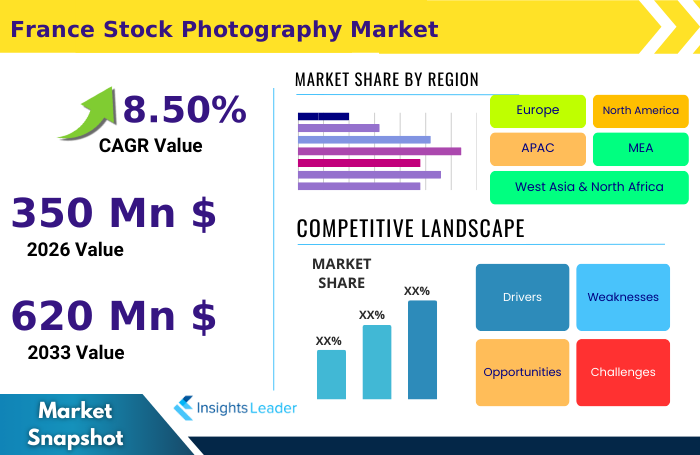
The France Stock Photography Market Size in 2026 is estimated to be USD 350 Million
What is the Growth Rate (CAGR) of France Stock Photography Market?
The France Stock Photography Market is expected to grow at 8.5% CAGR
What is the Market Size of the France Stock Photography in 2033?
The France Stock Photography Market Size in 2033 is estimated to be USD 620 Million
What are DRO and Impact Forces of France Stock Photography Market?
Drivers include the exponential growth in digital marketing, social media content needs, and the expansion of the French e-commerce sector requiring rich visual media. Restraints involve increasing competition from free stock platforms and the market disruption caused by generative Artificial Intelligence tools. Opportunities are focused on high-value niche content, such as authentic local French cultural imagery and specialized 360-degree virtual reality visuals.
What is Impact of U.S. Tariffs on France Stock Photography Market?
The direct impact of US tariffs on licensing fees for stock photography in France is negligible, as most transactions are digital services. However, indirect impacts include increased costs for high-end photography equipment and storage solutions, which rely heavily on global supply chains often affected by US-China trade tensions, subsequently increasing operating costs for professional contributors in the French market.
How is AI currently impacting France Stock Photography Market?
AI is fundamentally reshaping creative industries by enabling rapid content generation through diffusion models, leading to significant productivity gains but simultaneously challenging traditional intellectual property frameworks. Globally, AI is lowering the barrier to entry for content creation, automating personalization in advertising, and forcing stock content providers to focus on verifying data provenance and offering hyper-specific, authenticated human-centric visuals to counteract generic AI output.