Germany Online Loans Market Size and Insights – 2026 to 2033
Report ID : IL_6430 | Report Language's : En/Jp/Fr/De | Publisher : IL |
Format : 


What is the Market Size of the Germany Online Loans in 2026?
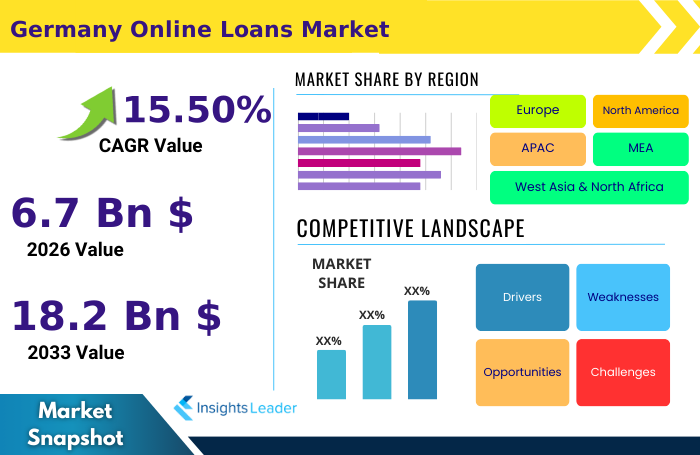
The Germany Online Loans Market Size in 2026 is estimated to be $6.7 Billion
What is the Growth Rate (CAGR) of Germany Online Loans Market?
The Germany Online Loans Market is expected to grow at 15.5% CAGR
What is the Market Size of the Germany Online Loans in 2033?
The Germany Online Loans Market Size in 2033 is estimated to be $18.2 Billion
What are DRO and Impact Forces of Germany Online Loans Market?
Drivers are rapid digitalization, high consumer demand for personalized financial products, and the integration of Open Banking APIs for streamlined applications. Restraints include stringent regulatory oversight from BaFin concerning consumer credit protection and the inherent risk associated with potential macroeconomic instability affecting loan defaults. Opportunities exist in leveraging embedded finance solutions and expanding into niche B2B online lending segments, while competitive intensity demands continuous technological innovation in risk assessment.
What is Impact of U.S. Tariffs on Germany Online Loans Market?
US tariffs on international trade have an indirect but consequential impact on the German Online Loans Market by primarily disrupting export-oriented sectors foundational to the national economy. This disruption can result in reduced industrial investment, subsequently dampening consumer confidence and disposable income necessary for loan repayment. Macroeconomic uncertainty driven by trade wars typically increases the perceived credit risk among online lenders, leading to stricter underwriting standards and potentially higher borrowing costs for businesses and consumers linked to affected supply chains.
How is AI currently impacting Germany Online Loans Market?
Artificial intelligence is currently profoundly impacting industries globally by enabling sophisticated predictive analytics, automating complex procedural tasks, and significantly enhancing personalized customer experiences across diverse sectors. In the financial domain, AI optimizes credit scoring models for improved accuracy, strengthens fraud detection capabilities through real-time monitoring, and drives the hyper-personalization of loan and service offers. These applications collectively lead to substantial operational efficiencies, lowered overhead costs, and improved competitive advantage for AI-adopting enterprises worldwide, accelerating the pace of digital transformation.