Malaysia Radiology Information System Market Size and Insights – 2026 to 2033
Report ID : IL_6283 | Report Language's : En/Jp/Fr/De | Publisher : IL |
Format : 


What is the Market Size of the Malaysia Radiology Information System in 2026?
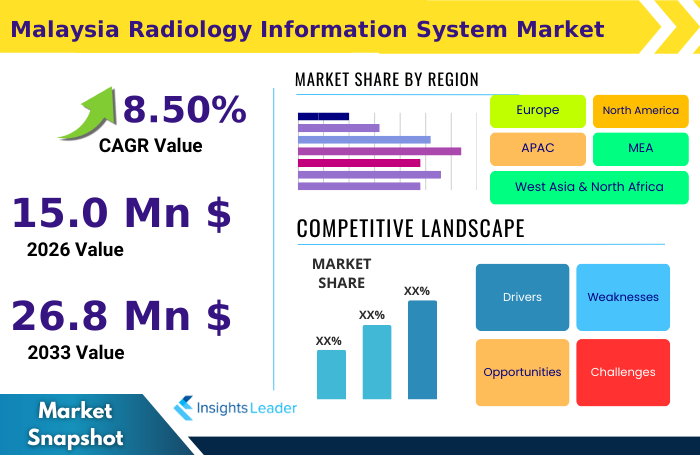
The Malaysia Radiology Information System Market Size in 2026 is estimated to be USD 15.0 Million
What is the Growth Rate (CAGR) of Malaysia Radiology Information System Market?
The Malaysia Radiology Information System Market is expected to grow at 8.5% CAGR
What is the Market Size of the Malaysia Radiology Information System in 2033?
The Malaysia Radiology Information System Market Size in 2033 is estimated to be USD 26.8 Million
What are DRO and Impact Forces of Malaysia Radiology Information System Market?
Drivers (D) include increasing healthcare digitalization, government initiatives (like MyDIGITAL), and the rising demand for efficient patient data management. Restraints (R) involve high initial investment costs for implementation and challenges related to data security and integration with legacy systems. Opportunities (O) are concentrated in the adoption of cloud-based RIS solutions and the incorporation of Artificial Intelligence for enhanced diagnostics and workflow automation.
What is Impact of U.S. Tariffs on Malaysia Radiology Information System Market?
While Malaysia’s domestic RIS market is primarily driven by local healthcare spending and regional vendors, US tariffs indirectly impact the cost structure through the global supply chain for medical hardware components, such as servers and computing infrastructure necessary for RIS deployment, which are often subject to trade disputes. This tariff pressure can lead to elevated procurement costs for Malaysian healthcare providers, marginally influencing the total cost of ownership for advanced RIS installations.
How is AI currently impacting Malaysia Radiology Information System Market?
AI is fundamentally reshaping global industries by enabling unprecedented levels of automation, optimizing complex supply chains, and offering predictive analytics for strategic decision-making across sectors such as manufacturing, finance, and healthcare. It drives efficiency through automated processes, reduces human error, and accelerates innovation by handling massive datasets quickly.