Russia Industrial Ethernet Market Size and Insights – 2026 to 2033
Report ID : IL_3029 | Report Language's : En/Jp/Fr/De | Publisher : IL |
Format : 



What is the Market Size of the Russia Industrial Ethernet in 2026?
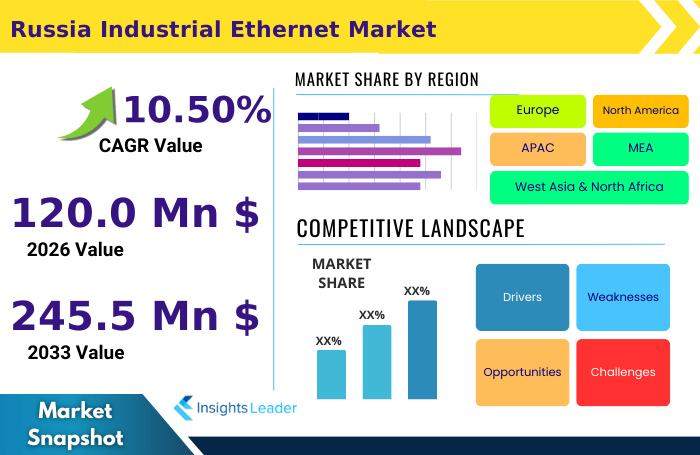
The Russia Industrial Ethernet Market Size in 2026 is estimated to be 120.0 Million USD
What is the Growth Rate (CAGR) of Russia Industrial Ethernet Market?
The Russia Industrial Ethernet Market is expected to grow at CAGR 10.5%
What is the Market Size of the Russia Industrial Ethernet in 2033?
The Russia Industrial Ethernet Market Size in 2033 is estimated to be 245.5 Million USD
What are DRO & Impact Forces?
Drivers include significant governmental mandates for the digitalization and modernization of heavy industrial sectors, necessitating high-speed, reliable networking infrastructure. Opportunities are emerging in localized manufacturing of components due to supply chain diversification mandates. Restraints primarily involve geopolitical uncertainty, reliance on specialized foreign technology, and the associated complexity of maintenance and standardization within highly varied industrial plants.
What is Impact of US tariffs?
US tariffs and subsequent sanctions have profoundly impacted the Russian Industrial Ethernet market by severely limiting access to established Western networking hardware and proprietary technology standards such as PROFINET and EtherCAT. This geopolitical constraint drives local industries to pivot toward alternative domestic or Asian suppliers, accelerating the adoption of open-source or domestically developed communication protocols, which can sometimes result in slower technological integration compared to global standards.
How is AI currently impacting industries globally?
Artificial Intelligence is transforming global industrial operations by demanding real-time data ingestion and processing capabilities, which necessitates the foundational backbone of high-bandwidth Industrial Ethernet networks. AI applications, such as predictive maintenance, quality inspection via machine vision, and dynamic resource allocation, rely on the low-latency communication provided by Industrial Ethernet to ensure deterministic responses and optimized operational efficiency across manufacturing and logistics supply chains.