South Korea Quality Management System (QMS) Market Size and Insights – 2026 to 2033
Report ID : IL_14875 | Report Language's : En/Jp/Fr/De | Publisher : IL |
Format : 


What is the Market Size of the South Korea Quality Management System (QMS) in 2026?
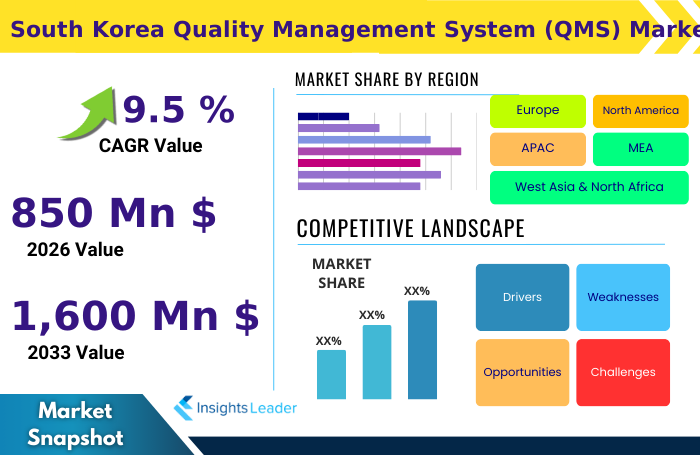
The South Korea Quality Management System (QMS) Market Size in 2026 is estimated to be USD 850 Million
What is the Growth Rate (CAGR) of South Korea Quality Management System (QMS) Market?
The South Korea Quality Management System (QMS) Market is expected to grow at CAGR 9.5%
What is the Market Size of the South Korea Quality Management System (QMS) in 2033?
The South Korea Quality Management System (QMS) Market Size in 2033 is estimated to be USD 1,600 Million
Report Snapshot
| Report Attributes | Report Details |
|---|---|
| Forecast Year | 2033 |
| CAGR | 9.5% |
| History Year | 2016-2024 |
| Market Size in 2026 | 850 Million USD |
| Market Size in 2033 | 1,600 Million USD |
What are DRO & Impact Forces of South Korea Quality Management System (QMS) Market?
Drivers include accelerated digital transformation mandates across key South Korean sectors (e.g., semiconductor, automotive) and the increasing complexity of international regulatory compliance. Restraints involve the high initial capital expenditure required for sophisticated cloud-based QMS solutions and resistance to change in traditional manufacturing environments. Opportunities are driven by the proliferation of specialized QMS modules targeting supply chain quality and environmental, social, and governance (ESG) reporting requirements. Impact forces center on geopolitical risks affecting export-dependent industries, necessitating robust and traceable quality systems.
What is Impact of US Tariffs on South Korea Quality Management System (QMS) Market?
The primary impact is indirect, manifesting through heightened supply chain volatility and the necessity for stricter quality control documentation for goods potentially affected by trade disputes. South Korean exporters, particularly in electronics and machinery, are increasing their investment in QMS platforms that offer superior audit trails and detailed traceability to mitigate risks associated with shifting origin rules and punitive duties. This indirectly drives demand for advanced QMS functionalities that support multiple regulatory environments simultaneously.
How is AI currently impacting South Korea Quality Management System (QMS) Market?
AI is fundamentally shifting QMS paradigms from reactive reporting to predictive quality management by analyzing vast datasets from IoT devices and production lines. AI algorithms facilitate automated non-conformance detection, predict equipment failure affecting quality, and accelerate root cause analysis, thereby reducing human error and improving overall operational efficiency within South Korean manufacturing enterprises. This integration is essential for maintaining competitive advantage in high-tech exports.
South Korea Quality Management System (QMS) Market Research Report – Table of Contents
1. Executive Summary
2. Introduction & Research Objectives
3. Scope of the Study
4. Research Methodology of South Korea Quality Management System (QMS) Market
5. South Korea Quality Management System (QMS) Market Overview & Industry Background
6. South Korea Quality Management System (QMS) Market Size & Forecast Analysis
7. South Korea Quality Management System (QMS) Market Segmentation Analysis
8. Competitive Landscape
9. Consumer Behavior & Demand Analysis
10. Pricing & Cost Structure Analysis
11. South Korea Quality Management System (QMS) Market Drivers, Challenges & Risks
12. Regulatory & Policy Framework
13. Technology & Innovation Impact
14. Strategic Insights & Recommendations
15. Conclusion & Future Outlook
For more queries, kindly contact [email protected]