South Korea Radiology Information System Market Size and Insights – 2026 to 2033
Report ID : IL_5883 | Report Language's : En/Jp/Fr/De | Publisher : IL |
Format : 


What is the Market Size of the South Korea Radiology Information System in 2026?
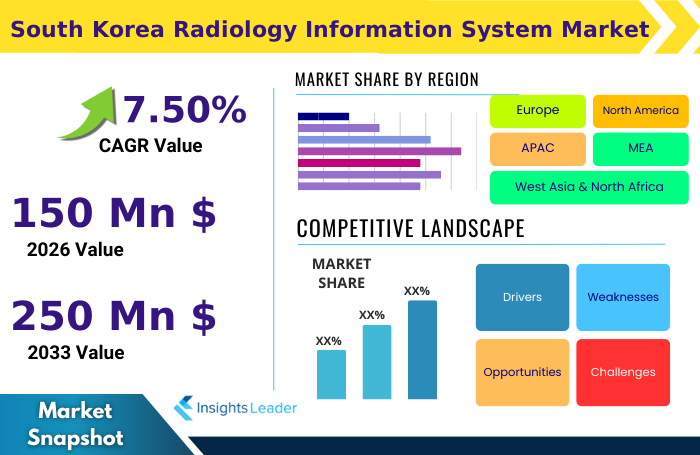
The South Korea Radiology Information System Market Size in 2026 is estimated to be USD 150 Million
What is the Growth Rate (CAGR) of South Korea Radiology Information System Market?
The South Korea Radiology Information System Market is expected to grow at 7.5% CAGR
What is the Market Size of the South Korea Radiology Information System in 2033?
The South Korea Radiology Information System Market Size in 2033 is estimated to be USD 250 Million
What are DRO and Impact Forces of South Korea Radiology Information System Market?
Drivers include accelerated digitalization of healthcare infrastructure and increasing governmental initiatives promoting integrated Electronic Health Records (EHRs). Restraints are primarily focused on the high initial capital expenditure required for system implementation and integration complexities with legacy systems. Opportunities are centered on the adoption of advanced cloud-based RIS platforms and the incorporation of artificial intelligence for workflow optimization and predictive scheduling.
What is Impact of U.S. Tariffs on South Korea Radiology Information System Market?
The direct impact of US tariffs on the South Korea Radiology Information System software market is assessed as minimal, given that most RIS platforms utilized are developed domestically or regionally. Indirect impacts may arise from tariffs affecting the global supply chain of critical hardware components, such as high-performance servers and specialized imaging workstations, potentially leading to slight upward pressure on total system procurement costs for end-users in South Korea.
How is AI currently impacting South Korea Radiology Information System Market?
Artificial Intelligence is globally impacting industries by driving unprecedented levels of automation, enhancing predictive analytics capabilities, and enabling highly personalized customer and patient experiences. In healthcare, AI improves diagnostic accuracy and speed, while in manufacturing, it optimizes supply chains and facilitates autonomous quality control, fundamentally redefining operational efficiencies across major economic sectors worldwide.