North America Smart Cities Market Size and Insights – 2026 to 2033
Report ID : IL_6099 | Report Language's : En/Jp/Fr/De | Publisher : IL |
Format : 


What is the Market Size of the North America Smart Cities in 2026?
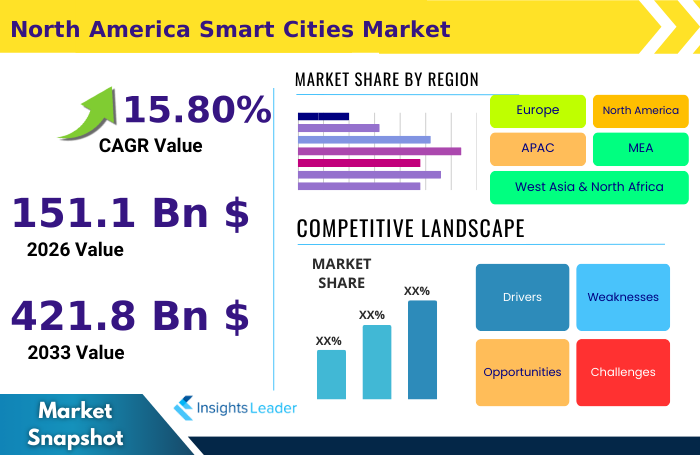
The North America Smart Cities Market Size in 2026 is estimated to be $151.1 Billion
What is the Growth Rate (CAGR) of North America Smart Cities Market?
The North America Smart Cities Market is expected to grow at 15.8% CAGR
What is the Market Size of the North America Smart Cities in 2033?
The North America Smart Cities Market Size in 2033 is estimated to be $421.8 Billion
What are DRO and Impact Forces of North America Smart Cities Market?
Drivers (D) are key growth accelerators such as increasing government investment in infrastructure modernization and rapid urbanization requiring efficient resource management. Restraints (R) include high initial implementation costs and significant public concern regarding data privacy and surveillance. Opportunities (O) involve leveraging emerging technologies like 5G, advanced AI analytics, and decentralized energy grids to create scalable solutions.
What is Impact of U.S. Tariffs on North America Smart Cities Market?
US tariffs primarily impact the Smart Cities market by elevating the procurement costs for key hardware components such as sensors, networking equipment, and specialized cameras, often sourced from specific international regions. This cost increase puts pressure on municipal budgets, potentially decelerating project timelines or shifting supply chain reliance toward domestic or non-tariff-affected suppliers to mitigate financial risk and ensure project viability.
How is AI currently impacting North America Smart Cities Market?
AI is fundamentally transforming industries globally by enabling massive operational efficiencies, sophisticated predictive modeling, and highly personalized service delivery across diverse sectors. Key applications include optimizing global supply chain logistics, enhancing cybersecurity posture through real-time threat detection, accelerating pharmaceutical R&D, and providing crucial real-time data analysis necessary for managing resilient smart infrastructure and optimizing energy consumption patterns.