Italy Smart Cities Market Size and Insights – 2026 to 2033
Report ID : IL_6339 | Report Language's : En/Jp/Fr/De | Publisher : IL |
Format : 


What is the Market Size of the Italy Smart Cities in 2026?
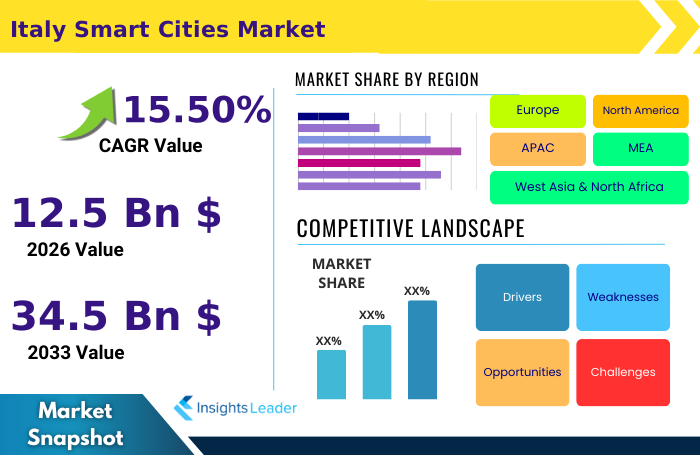
The Italy Smart Cities Market Size in 2026 is estimated to be USD 12.5 Billion
What is the Growth Rate (CAGR) of Italy Smart Cities Market?
The Italy Smart Cities Market is expected to grow at 15.5% CAGR
What is the Market Size of the Italy Smart Cities in 2033?
The Italy Smart Cities Market Size in 2033 is estimated to be USD 34.5 Billion
What are DRO and Impact Forces of Italy Smart Cities Market?
Drivers include significant public funding through the National Recovery and Resilience Plan (PNRR) focusing on digitalization and green transition, coupled with high urbanization rates demanding efficient municipal services. Restraints involve the complexity of integrating legacy infrastructure with modern IoT ecosystems and the initial high capital expenditure required for large-scale deployments. Opportunities are substantial in developing data-driven urban mobility solutions and enhancing public safety platforms.
What is Impact of U.S. Tariffs on Italy Smart Cities Market?
The impact of US tariffs on the Italian Smart Cities market is largely indirect, affecting global supply chain stability and the cost of essential hardware components, particularly advanced semiconductor chips and network equipment sourced from Asian suppliers subject to trade restrictions. While Italy is not directly targeted, global price inflation for technology components can raise procurement costs for Italian municipalities and system integrators, potentially slowing project timelines or requiring budget reassessment for major smart infrastructure initiatives.
How is AI currently impacting Italy Smart Cities Market?
AI is fundamentally transforming global industrial landscapes by enabling hyper-automation, predictive maintenance, and sophisticated risk modeling across sectors like finance, manufacturing, and logistics. It enhances operational efficiency, drives personalized customer experiences, and accelerates decision-making processes by analyzing vast datasets in real-time, thereby setting new benchmarks for productivity and competitive differentiation globally.