Indonesia Application Security Market Size and Insights – 2026 to 2033
Report ID : IL_6385 | Report Language's : En/Jp/Fr/De | Publisher : IL |
Format : 


What is the Market Size of the Indonesia Application Security in 2026?
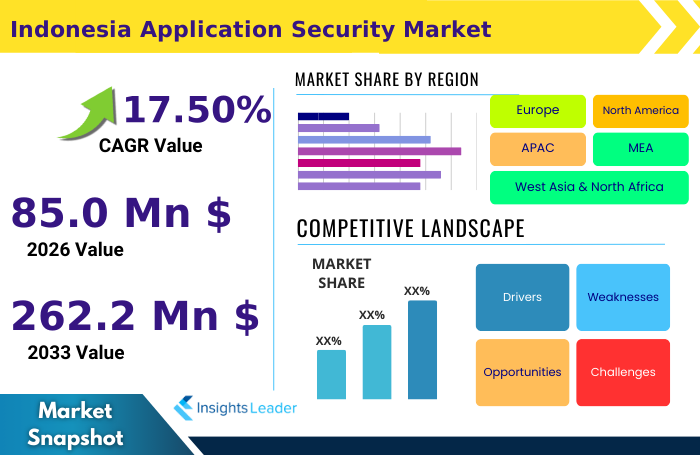
The Indonesia Application Security Market Size in 2026 is estimated to be USD 85.0 Million
What is the Growth Rate (CAGR) of Indonesia Application Security Market?
The Indonesia Application Security Market is expected to grow at CAGR 17.5%
What is the Market Size of the Indonesia Application Security in 2033?
The Indonesia Application Security Market Size in 2033 is estimated to be USD 262.2 Million
What are DRO and Impact Forces of Indonesia Application Security Market?
Drivers include accelerated digital transformation across BFSI and e-commerce sectors, coupled with increasingly stringent government regulations on data privacy and application integrity. Restraints often involve the lack of highly skilled cybersecurity professionals locally and high initial costs associated with advanced security solutions. Opportunities are concentrated in managed security services (MSS) and cloud-native application protection (CNAPP) platforms.
What is Impact of U.S. Tariffs on Indonesia Application Security Market?
The direct impact of US tariffs on the Indonesian Application Security Market is generally low, as the market is primarily software and services driven, minimizing exposure to hardware-centric trade wars. However, tariffs can indirectly increase the cost of underlying hardware infrastructure (servers and network equipment) for Indonesian enterprises, potentially shrinking overall IT budgets and consequently slowing enterprise investment in new or advanced application security tools.
How is AI currently impacting Indonesia Application Security Market?
AI is fundamentally reshaping global industries by enabling vast automation of routine processes and enhancing predictive capabilities in risk management and operational efficiency. It plays a critical role in personalization for customer experiences and supply chain optimization. Within the cybersecurity field, AI and machine learning drastically improve threat detection accuracy, reduce the reliance on signature-based defenses, and enable proactive defense strategies against zero-day exploits.