Malaysia Application Security Market Size and Insights – 2026 to 2033
Report ID : IL_6265 | Report Language's : En/Jp/Fr/De | Publisher : IL |
Format : 


What is the Market Size of the Malaysia Application Security in 2026?
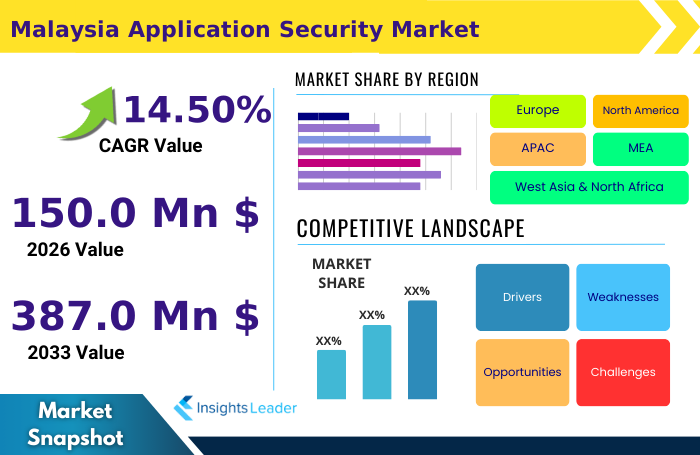
The Malaysia Application Security Market Size in 2026 is estimated to be USD 150.0 Million
What is the Growth Rate (CAGR) of Malaysia Application Security Market?
The Malaysia Application Security Market is expected to grow at 14.5% CAGR
What is the Market Size of the Malaysia Application Security in 2033?
The Malaysia Application Security Market Size in 2033 is estimated to be USD 387.0 Million
What are DRO and Impact Forces of Malaysia Application Security Market?
Drivers include mandatory compliance standards such as the Personal Data Protection Act (PDPA) and rapid enterprise migration to cloud-native applications. Restraints involve the high initial cost of deploying sophisticated security solutions and a critical shortage of skilled local cybersecurity professionals. Opportunities lie in integrating application security testing earlier in the DevOps pipeline through DevSecOps models.
What is Impact of U.S. Tariffs on Malaysia Application Security Market?
The impact of US tariffs is primarily indirect, affecting the supply chain and increasing the procurement cost of crucial networking hardware and IT infrastructure necessary to support application security deployments. While tariffs do not directly target application security software, they can increase overall operational expenditure (OpEx) for Malaysian businesses, potentially delaying non-essential security investment upgrades.
How is AI currently impacting Malaysia Application Security Market?
AI is fundamentally changing security postures globally by automating complex threat detection, vulnerability analysis, and incident response processes across financial, healthcare, and governmental sectors. Simultaneously, malicious actors are leveraging AI to generate highly sophisticated, polymorphic malware and conduct automated, scalable social engineering attacks, driving the demand for AI-driven defensive security tools.