Asia-Pacific Application Security Market Size and Insights – 2026 to 2033
Report ID : IL_6785 | Report Language's : En/Jp/Fr/De | Publisher : IL |
Format : 



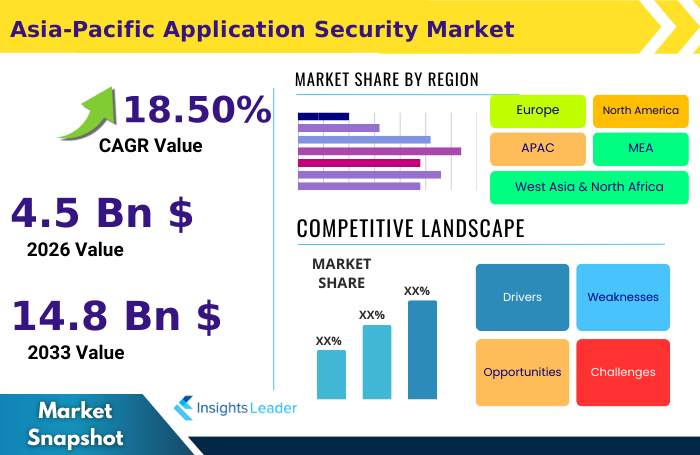
What is the Market Size of the Asia-Pacific Application Security in 2026?
The Asia-Pacific Application Security Market Size in 2026 is estimated to be USD 4.5 Billion
What is the Growth Rate (CAGR) of Asia-Pacific Application Security Market?
The Asia-Pacific Application Security Market is expected to grow at 18.5% CAGR
What is the Market Size of the Asia-Pacific Application Security in 2033?
The Asia-Pacific Application Security Market Size in 2033 is estimated to be USD 14.8 Billion
What are DRO and Impact Forces of Asia-Pacific Application Security Market?
Drivers include accelerated digital transformation and stringent governmental compliance requirements (e.g., in finance and healthcare). Restraints often involve the scarcity of skilled cybersecurity professionals and the high initial investment cost for advanced testing tools. Opportunities lie in the proliferation of DevSecOps practices and the integration of AI-driven security automation across the software development lifecycle.
What is Impact of U.S. Tariffs on Asia-Pacific Application Security Market?
The imposition of US tariffs and broader trade tensions has led to accelerated strategic shifts within the APAC region, particularly concerning technology supply chains. This geopolitical climate encourages domestic application development and software independence in key regional economies like China and India. Consequently, the demand for localized and sovereign application security solutions has seen a marked increase, driving market growth for native APAC security vendors and tailored services.
How is AI currently impacting Asia-Pacific Application Security Market?
Artificial Intelligence is fundamentally transforming industries globally by enhancing automation, improving predictive analytics, and enabling personalized user experiences. In the context of cybersecurity, AI/ML models are critical for detecting zero-day vulnerabilities, automating routine security tasks, and significantly improving the efficiency of Static Application Security Testing (SAST) and Dynamic Application Security Testing (DAST) tools by reducing false positives and accelerating remediation.