Australia Wearable Technology Market Size and Insights – 2026 to 2033
Report ID : IL_3223 | Report Language's : En/Jp/Fr/De | Publisher : IL |
Format : 


What is the Market Size of the Australia Wearable Technology in 2026?
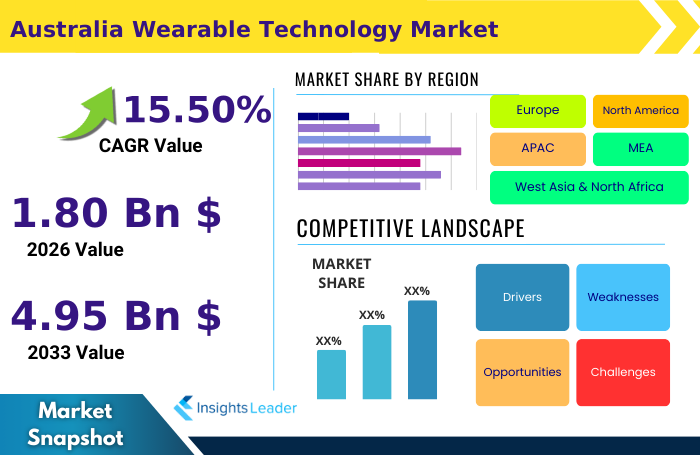
The Australia Wearable Technology Market Size in 2026 is estimated to be $1.80 Billion
What is the Growth Rate (CAGR) of Australia Wearable Technology Market?
The Australia Wearable Technology Market is expected to grow at CAGR 15.5%
What is the Market Size of the Australia Wearable Technology in 2033?
The Australia Wearable Technology Market Size in 2033 is estimated to be $4.95 Billion
What are DRO & Impact Forces?
Drivers, Restraints, and Opportunities (DRO) are foundational elements analyzing market dynamics. Drivers propel growth (e.g., increased health consciousness), Restraints inhibit growth (e.g., high device cost or data privacy concerns), and Opportunities are potential future avenues for expansion (e.g., integration into enterprise wellness programs). Impact Forces refer to macro-environmental factors, such as technological shifts, regulatory changes, or economic volatility, that significantly alter market trajectory or competitiveness.
What is Impact of US tariffs?
While direct US tariffs primarily target goods sourced from specific countries, their indirect impact on the Australian wearable technology market manifests through global supply chain disruption and increased component costs. Australian distributors and original equipment manufacturers (OEMs) relying on global component sourcing, especially from Asia, face higher procurement expenses, which are often passed on to consumers or result in reduced profit margins. This global cost inflation slightly dampens affordability and accessibility within the regional market.
How is AI currently impacting industries globally?
Artificial intelligence (AI) is transforming global industries by optimizing operational efficiency, enhancing decision-making through predictive analytics, and enabling hyper-personalization of services. In healthcare, AI facilitates diagnostics and personalized medicine; in manufacturing, it powers predictive maintenance and autonomous quality control; and in finance, it drives algorithmic trading and fraud detection. Globally, AI integration is leading to significant shifts in labor demand and creating new categories of specialized services centered around data interpretation and automation.