Japan Low Rolling Resistance Tires (LRRT) Market Size and Insights – 2026 to 2033
Report ID : IL_15292 | Report Language's : En/Jp/Fr/De | Publisher : IL |
Format : 



What is the Market Size of the Japan Low Rolling Resistance Tires (LRRT) in 2026?
The Japan Low Rolling Resistance Tires (LRRT) Market Size in 2026 is estimated to be USD 4.50 Billion
What is the Growth Rate (CAGR) of Japan Low Rolling Resistance Tires (LRRT) Market?
The Japan Low Rolling Resistance Tires (LRRT) Market is expected to grow at 5.8% CAGR
What is the Market Size of the Japan Low Rolling Resistance Tires (LRRT) in 2033?
The Japan Low Rolling Resistance Tires (LRRT) Market Size in 2033 is estimated to be USD 6.70 Billion
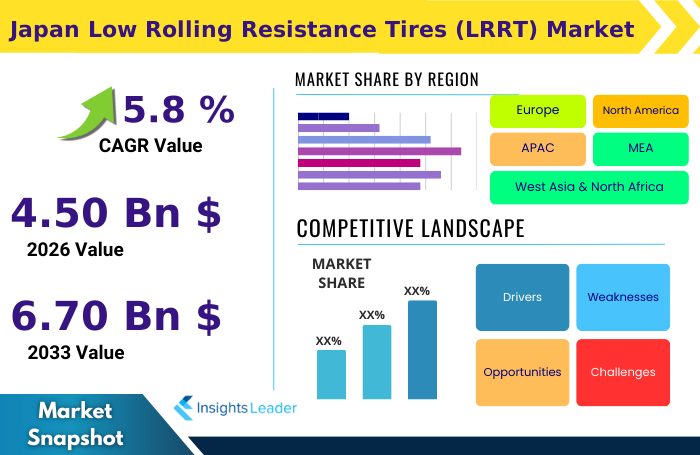
Report Snapshot
| Report Attributes | Report Details |
|---|---|
| Forecast Year | 2033 |
| CAGR | 5.8% |
| History Year | 2016-2024 |
| Market Size in 2026 | 4.50 Billion USD |
| Market Size in 2033 | 6.70 Billion USD |
What are DRO & Impact Forces of Japan Low Rolling Resistance Tires (LRRT) Market?
The market drivers (D) include stringent Japanese governmental mandates on vehicle fuel efficiency and the rapid adoption of electric vehicles (EVs), which benefit significantly from extended range provided by LRRT technology. Opportunities (O) arise from advancements in material science, particularly the use of high-dispersion silica and specialized polymers, enabling better performance balance.The key impact forces (I) relate primarily to raw material price volatility, particularly for synthetic rubber and specialty chemicals, which affects manufacturing costs. Furthermore, intense competition among major domestic players (Bridgestone, Yokohama) and global competitors exerts downward pressure on average selling prices.
What is Impact of US Tariffs on Japan Low Rolling Resistance Tires (LRRT) Market?
While the direct sale of LRRTs manufactured in Japan to the U.S. market may face tariff hurdles, the primary impact is indirect, involving disruptions to global supply chains for critical components and specialized manufacturing equipment necessary for LRRT production.These tariffs induce manufacturing optimization strategies, potentially leading Japanese tire manufacturers to increase production localization within third-party countries or accelerate investment in highly efficient, automated production lines domestically to mitigate rising export costs and remain competitive globally.
How is AI currently impacting Japan Low Rolling Resistance Tires (LRRT) Market?
Artificial Intelligence (AI) significantly influences the LRRT sector through advanced R&D and manufacturing optimization. AI-driven simulation models allow engineers to rapidly test thousands of new compound formulations and tread designs, achieving the optimal balance between ultra-low rolling resistance, wet grip, and wear life without extensive physical prototyping. Furthermore, AI is crucial in predictive maintenance services offered to commercial fleets using LRRTs, optimizing tire management and reducing total cost of ownership.
Japan Low Rolling Resistance Tires (LRRT) Market Research Report – Table of Contents
1. Executive Summary
2. Introduction & Research Objectives
3. Scope of the Study
4. Research Methodology of Japan Low Rolling Resistance Tires (LRRT) Market
5. Japan Low Rolling Resistance Tires (LRRT) Market Overview & Industry Background
6. Japan Low Rolling Resistance Tires (LRRT) Market Size & Forecast Analysis
7. Japan Low Rolling Resistance Tires (LRRT) Market Segmentation Analysis
8. Competitive Landscape
9. Consumer Behavior & Demand Analysis
10. Pricing & Cost Structure Analysis
11. Japan Low Rolling Resistance Tires (LRRT) Market Drivers, Challenges & Risks
12. Regulatory & Policy Framework
13. Technology & Innovation Impact
14. Strategic Insights & Recommendations
15. Conclusion & Future Outlook
For more queries, kindly contact [email protected]