Asia-Pacific Hem Adhesive Market Size and Insights – 2026 to 2033
Report ID : IL_15780 | Report Language's : En/Jp/Fr/De | Publisher : IL |
Format : 



What is the Market Size of the Asia-Pacific Hem Adhesive in 2026?
The Asia-Pacific Hem Adhesive Market Size in 2026 is estimated to be USD 850 Million
What is the Growth Rate (CAGR) of Asia-Pacific Hem Adhesive Market?
The Asia-Pacific Hem Adhesive Market is expected to grow at 6.8% CAGR
What is the Market Size of the Asia-Pacific Hem Adhesive in 2033?
The Asia-Pacific Hem Adhesive Market Size in 2033 is estimated to be USD 1,355 Million
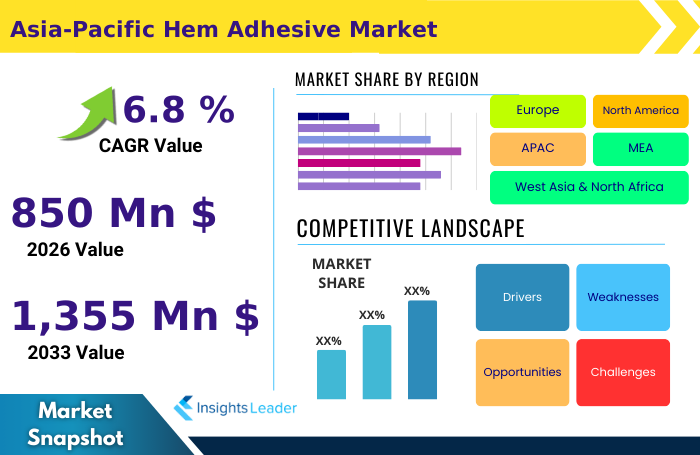
Report Snapshot
| Report Attributes | Report Details |
|---|---|
| Forecast Year | 2033 |
| CAGR | 6.8% |
| History Year | 2016-2024 |
| Market Size in 2026 | 850 Million USD |
| Market Size in 2033 | 1,355 Million USD |
What are DRO & Impact Forces of Asia-Pacific Hem Adhesive Market?
Drivers: Rapid expansion of the automotive sector, driven by electric vehicle (EV) manufacturing and increased automation in assembly lines, particularly in China, Japan, and South Korea.Restraints: Volatility in raw material prices, specifically petrochemical derivatives, coupled with stringent environmental regulations concerning volatile organic compound (VOC) emissions in developed APAC economies.Opportunities: Growing demand for lightweighting solutions in vehicle construction to enhance fuel efficiency and battery range, favoring high-performance, lightweight hem adhesives over traditional welding.Impact Forces: Technological shifts toward multi-substrate bonding (e.g., steel to aluminum) and the critical need for adhesives that provide superior crash performance and structural integrity.
What is Impact of US Tariffs on Asia-Pacific Hem Adhesive Market?
U.S. tariffs primarily impact intermediate goods and finished vehicles manufactured in key APAC countries, leading to adjustments in supply chain logistics and manufacturing location strategies.While hem adhesives are often specialized chemicals, tariffs on derived raw materials or finished components can increase the overall cost of production for automakers operating within the region.This scenario can accelerate regionalization, prompting manufacturers to source raw materials and adhesives locally within the APAC trade bloc (e.g., RCEP member states) to mitigate exposure to transatlantic trade disputes.The indirect effect includes a dampened export market for APAC vehicles, potentially slowing down domestic automotive production growth, which is a primary end-user for hem adhesives.
How is AI currently impacting Asia-Pacific Hem Adhesive Market?
AI is influencing the hem adhesive market primarily through optimizing manufacturing processes and enhancing quality control. Machine learning algorithms are used for predictive maintenance of dispensing equipment, ensuring consistent bead placement and curing cycles, which is critical for structural bonding applications. Furthermore, AI-driven simulation tools allow R&D teams to model complex joint designs and predict adhesive performance under varying climatic and mechanical stress conditions, accelerating product development cycles. This allows APAC manufacturers to quickly adapt formulations for emerging lightweight substrates.
Asia-Pacific Hem Adhesive Market Research Report – Table of Contents
1. Executive Summary
2. Introduction & Research Objectives
3. Scope of the Study
4. Research Methodology of Asia-Pacific Hem Adhesive Market
5. Asia-Pacific Hem Adhesive Market Overview & Industry Background
6. Asia-Pacific Hem Adhesive Market Size & Forecast Analysis
7. Asia-Pacific Hem Adhesive Market Segmentation Analysis
8. Competitive Landscape
9. Consumer Behavior & Demand Analysis
10. Pricing & Cost Structure Analysis
11. Asia-Pacific Hem Adhesive Market Drivers, Challenges & Risks
12. Regulatory & Policy Framework
13. Technology & Innovation Impact
14. Strategic Insights & Recommendations
15. Conclusion & Future Outlook
For more queries, kindly contact [email protected]