Australia Hydrochloric Acid (HCI) Market Size and Insights – 2026 to 2033
Report ID : IL_7398 | Report Language's : En/Jp/Fr/De | Publisher : IL |
Format : 



What is the Market Size of the Australia Hydrochloric Acid (HCI) in 2026?
The Australia Hydrochloric Acid (HCI) Market Size in 2026 is estimated to be USD 45.0 Million
What is the Growth Rate (CAGR) of Australia Hydrochloric Acid (HCI) Market?
The Australia Hydrochloric Acid (HCI) Market is expected to grow at 4.3% CAGR
What is the Market Size of the Australia Hydrochloric Acid (HCI) in 2033?
The Australia Hydrochloric Acid (HCI) Market Size in 2033 is estimated to be USD 60.6 Million
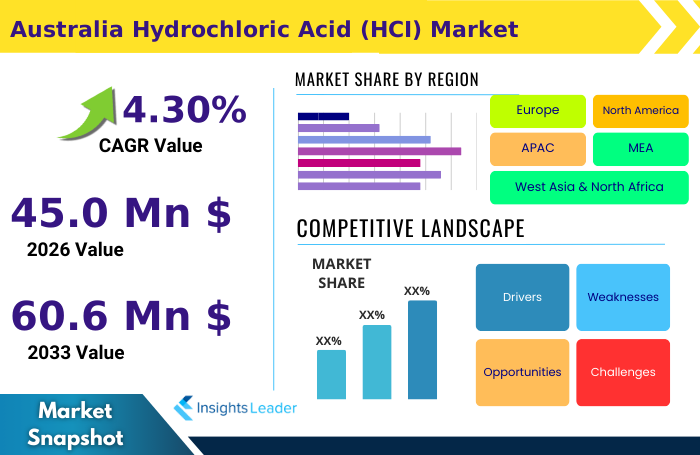
Report Snapshot
| Report Attributes | Report Details |
|---|---|
| Forecast Year | 2033 |
| CAGR | 4.3% |
| History Year | 2016-2024 |
| Market Size in 2026 | 45.0 Mn USD$ |
| Market Size in 2033 | 60.6 Mn USD$ |
What are DRO and Impact Forces of Australia Hydrochloric Acid (HCI) Market?
DRO stands for Drivers, Restraints, and Opportunities, which are critical analytical components defining market evolution. Drivers propelling the Australian HCI market include sustained high demand from the vital mining sector for ore leaching and pH adjustment, especially in gold and uranium processing. Furthermore, expansion in industrial and municipal water treatment plants mandates increased consumption for effluent neutralization and pH control.
What is Impact of U.S. Tariffs on Australia Hydrochloric Acid (HCI) Market?
The Australian hydrochloric acid market experiences minimal direct consequence from US tariffs due to the chemical’s bulk nature and prohibitive transportation costs, meaning trade is localized or regionalized rather than reliant on direct transatlantic imports. Domestic production adequately services the majority of Australian industrial demand.
How is AI currently impacting Australia Hydrochloric Acid (HCI) Market?
Artificial Intelligence (AI) is fundamentally transforming industrial operations worldwide by enabling unprecedented levels of efficiency and optimization. In the chemical manufacturing sector, AI is deployed to implement predictive maintenance schedules, drastically reducing unplanned downtime and maximizing asset lifespan through the analysis of sensor data and operational parameters.
Furthermore, AI-powered systems are revolutionizing supply chain management by providing advanced demand forecasting, optimizing inventory levels, and enhancing logistical routing, thereby increasing resilience against global disruptions. Globally, AI accelerates research and development, particularly in material science and formulation chemistry, using simulation models to predict compound behavior and shorten the time-to-market for novel industrial products.
Australia Hydrochloric Acid (HCI) Market Research Report – Table of Contents
1. Executive Summary
2. Introduction & Research Objectives
3. Scope of the Study
4. Research Methodology of Australia Hydrochloric Acid (HCI) Market
5. Australia Hydrochloric Acid (HCI) Market Overview & Industry Background
6. Australia Hydrochloric Acid (HCI) Market Size & Forecast Analysis
7. Australia Hydrochloric Acid (HCI) Market Segmentation Analysis
8. Competitive Landscape
9. Consumer Behavior & Demand Analysis
10. Pricing & Cost Structure Analysis
11. Australia Hydrochloric Acid (HCI) Market Drivers, Challenges & Risks
12. Regulatory & Policy Framework
13. Technology & Innovation Impact
14. Strategic Insights & Recommendations
15. Conclusion & Future Outlook
For more queries, kindly contact [email protected]