Europe Polylactic Acid Market Size and Insights – 2026 to 2033
Report ID : IL_6517 | Report Language's : En/Jp/Fr/De | Publisher : IL |
Format : 


What is the Market Size of the Europe Polylactic Acid in 2026?
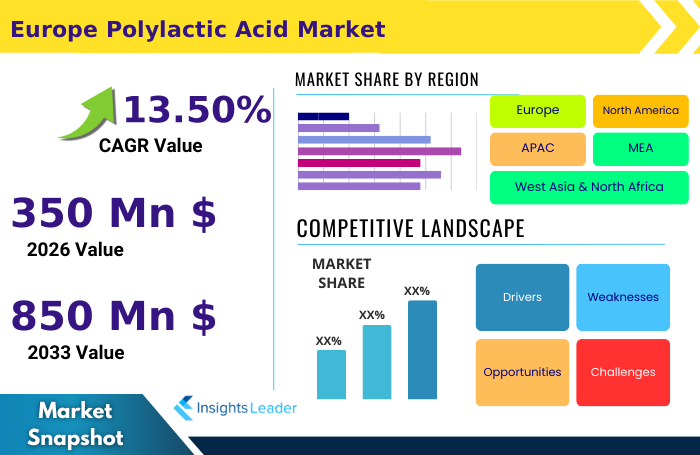
The Europe Polylactic Acid Market Size in 2026 is estimated to be USD 350 Million
What is the Growth Rate (CAGR) of Europe Polylactic Acid Market?
The Europe Polylactic Acid Market is expected to grow at CAGR 13.5%
What is the Market Size of the Europe Polylactic Acid in 2033?
The Europe Polylactic Acid Market Size in 2033 is estimated to be USD 850 Million
What are DRO and Impact Forces of Europe Polylactic Acid Market?
DRO (Drivers, Restraints, Opportunities) represents the foundational framework utilized for comprehensive strategic market assessment. Drivers are positive factors fueling growth, Restraints are inhibiting factors, and Opportunities are potential avenues for market expansion. Impact Forces refer to significant external macro-environmental variables, such as regulatory changes, technological advancements, and geopolitical shifts, which exert substantial pressure on market dynamics and strategic decision-making.
What is Impact of U.S. Tariffs on Europe Polylactic Acid Market?
The impact of US tariffs on the European PLA market primarily manifests through disrupted global supply chains for raw materials (lactic acid derivatives) or finished products originating from or routed through affected regions. Tariffs introduce significant uncertainty regarding input costs, potentially increasing manufacturing expenses for European producers, especially if key sourcing regions are targeted. Furthermore, these trade barriers can indirectly influence the competitiveness of petroleum-based plastics relative to PLA, altering the cost-benefit analysis for end-users in packaging and textiles.
How is AI currently impacting Europe Polylactic Acid Market?
AI is currently transforming global industries by optimizing operational efficiencies, accelerating research and development cycles, and enabling predictive modeling. In manufacturing, AI drives predictive maintenance, minimizing downtime and optimizing resource allocation. For supply chains, machine learning algorithms forecast demand with greater accuracy, reducing inventory costs. Moreover, AI facilitates personalized customer experiences and enhances data-driven decision-making across enterprise functions, fundamentally reshaping competitive landscapes.