Brazil Low Rolling Resistance Tires (LRRT) Market Size and Insights – 2026 to 2033
Report ID : IL_15652 | Report Language's : En/Jp/Fr/De | Publisher : IL |
Format : 



What is the Market Size of the Brazil Low Rolling Resistance Tires (LRRT) in 2026?
The Brazil Low Rolling Resistance Tires (LRRT) Market Size in 2026 is estimated to be USD 450 Million
What is the Growth Rate (CAGR) of Brazil Low Rolling Resistance Tires (LRRT) Market?
The Brazil Low Rolling Resistance Tires (LRRT) Market is expected to grow at 8.5% CAGR
What is the Market Size of the Brazil Low Rolling Resistance Tires (LRRT) in 2033?
The Brazil Low Rolling Resistance Tires (LRRT) Market Size in 2033 is estimated to be USD 800 Million
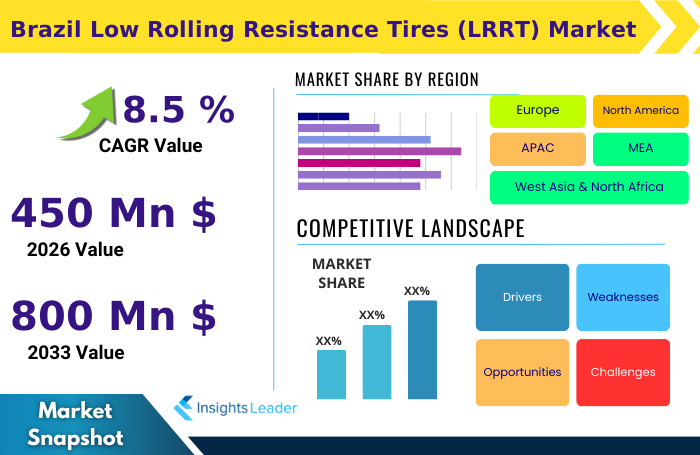
Report Snapshot
| Report Attributes | Report Details |
|---|---|
| Forecast Year | 2033 |
| CAGR | 8.5% |
| History Year | 2016-2024 |
| Market Size in 2026 | 450 Million USD |
| Market Size in 2033 | 800 Million USD |
What are DRO & Impact Forces of Brazil Low Rolling Resistance Tires (LRRT) Market?
Dynamics driving the LRRT market include stringent regulatory requirements enforced by INMETRO regarding tire labeling and fuel efficiency standards, coupled with sustained high fuel prices encouraging fleet operators and consumers to adopt cost-saving solutions. Furthermore, the push towards sustainability and lower carbon emissions in corporate fleets accelerates demand for LRRTs.Restraints primarily involve the higher initial manufacturing and retail cost of advanced LRRTs compared to traditional alternatives, which can deter price-sensitive segments of the Brazilian replacement market. Opportunities center on the rapid expansion of the electric vehicle (EV) segment in Brazil, as EVs critically require specialized LRRTs to maximize battery range and efficiency, creating a premium market niche.
What is Impact of US Tariffs on Brazil Low Rolling Resistance Tires (LRRT) Market?
U.S. tariffs, particularly those imposed on tires originating from major Asian manufacturing hubs, indirectly influence the Brazilian market by causing global supply chain diversion. This often leads to increased supply from tariff-affected regions being redirected into the unprotected Latin American market, potentially resulting in localized price depression and intensified competition for domestic Brazilian producers.Conversely, multinational tire manufacturers operating production facilities within Brazil may benefit from improved cost competitiveness in select export markets not targeted by U.S. duties. The primary long-term impact involves necessitating strategic sourcing adjustments for raw materials and shifting investment decisions regarding manufacturing capacity expansion within the Mercosur region.
How is AI currently impacting Brazil Low Rolling Resistance Tires (LRRT) Market?
Artificial Intelligence (AI) is transforming LRRT manufacturing by optimizing the compounding process using machine learning to achieve the perfect balance between low rolling resistance and high wet grip, improving product performance. AI-driven predictive maintenance systems are being deployed to monitor equipment in Brazilian tire plants, reducing downtime and maximizing operational efficiency, crucial for maintaining competitive production costs. Furthermore, AI algorithms are vital in logistics planning and demand forecasting across the vast distribution network, ensuring timely supply and minimizing inventory holding costs within the Brazilian market landscape.
Brazil Low Rolling Resistance Tires (LRRT) Market Research Report – Table of Contents
1. Executive Summary
2. Introduction & Research Objectives
3. Scope of the Study
4. Research Methodology of Brazil Low Rolling Resistance Tires (LRRT) Market
5. Brazil Low Rolling Resistance Tires (LRRT) Market Overview & Industry Background
6. Brazil Low Rolling Resistance Tires (LRRT) Market Size & Forecast Analysis
7. Brazil Low Rolling Resistance Tires (LRRT) Market Segmentation Analysis
8. Competitive Landscape
9. Consumer Behavior & Demand Analysis
10. Pricing & Cost Structure Analysis
11. Brazil Low Rolling Resistance Tires (LRRT) Market Drivers, Challenges & Risks
12. Regulatory & Policy Framework
13. Technology & Innovation Impact
14. Strategic Insights & Recommendations
15. Conclusion & Future Outlook
For more queries, kindly contact [email protected]