South Korea Smart Cities Market Size and Insights – 2026 to 2033
Report ID : IL_5859 | Report Language's : En/Jp/Fr/De | Publisher : IL |
Format : 


What is the Market Size of the South Korea Smart Cities in 2026?
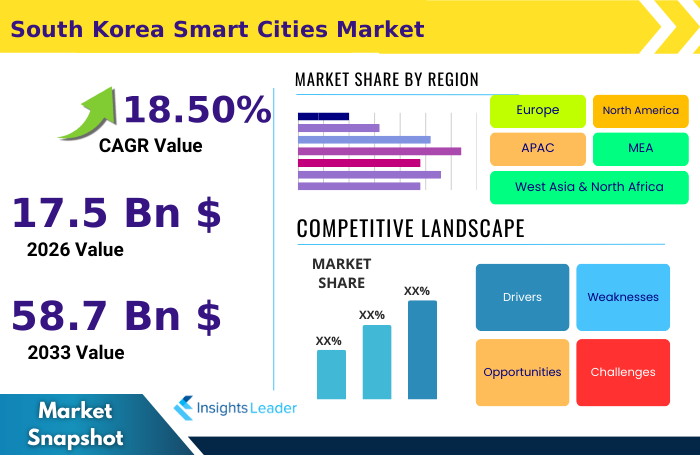
The South Korea Smart Cities Market Size in 2026 is estimated to be USD 17.5 Billion
What is the Growth Rate (CAGR) of South Korea Smart Cities Market?
The South Korea Smart Cities Market is expected to grow at 18.5% CAGR
What is the Market Size of the South Korea Smart Cities in 2033?
The South Korea Smart Cities Market Size in 2033 is estimated to be USD 58.7 Billion
What are DRO and Impact Forces of South Korea Smart Cities Market?
DRO refers to Drivers, Restraints, and Opportunities. Key drivers include substantial government investment in smart infrastructure projects (e.g., Busan Eco Delta City) and rapid adoption of 5G technology. Restraints primarily involve high initial deployment costs and significant data privacy concerns. Opportunities lie in integrating AI for predictive maintenance and developing specialized services for aging populations.
What is Impact of U.S. Tariffs on South Korea Smart Cities Market?
The impact of US tariffs on the South Korean Smart Cities market is primarily indirect, affecting the global supply chain stability for crucial networking components, sensors, and semiconductors necessary for smart infrastructure deployment. This market uncertainty can lead to marginal increases in procurement costs for hardware, prompting South Korean firms to prioritize diversification of their supplier base away from tariff-impacted regions, focusing on reliable domestic or non-tariffed international partners.
How is AI currently impacting South Korea Smart Cities Market?
Artificial Intelligence is transforming global industries by enabling advanced automation, optimizing complex supply chains through predictive analytics, and drastically improving resource management in energy and logistics sectors. Furthermore, AI facilitates highly personalized customer experiences and drives the foundational intelligence layer for next-generation smart infrastructure, allowing real-time decision-making and preventative maintenance across critical systems.