North America Wearable Technology Market Size and Insights – 2026 to 2033
Report ID : IL_3063 | Report Language's : En/Jp/Fr/De | Publisher : IL |
Format : 


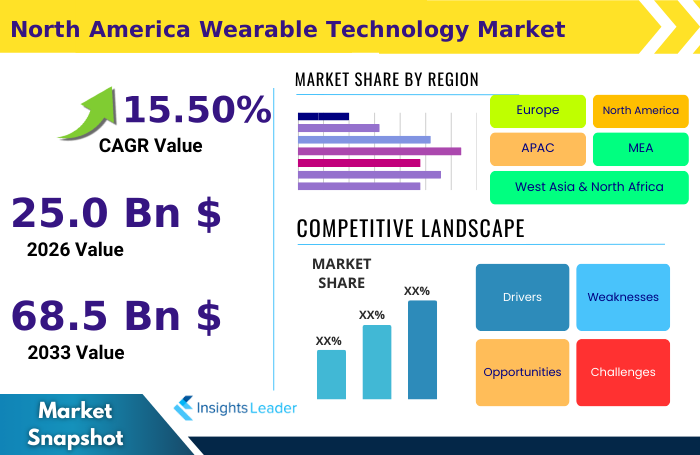
What is the Market Size of the North America Wearable Technology in 2026?
The North America Wearable Technology Market Size in 2026 is estimated to be $25.0 Billion
What is the Growth Rate (CAGR) of North America Wearable Technology Market?
The North America Wearable Technology Market is expected to grow at CAGR 15.5%
What is the Market Size of the North America Wearable Technology in 2033?
The North America Wearable Technology Market Size in 2033 is estimated to be $68.5 Billion
What are DRO & Impact Forces?
DRO (Dynamics, Risks, and Opportunities) constitutes a comprehensive framework for strategic market analysis, evaluating the evolutionary changes (Dynamics), potential threats (Risks such as regulatory non-compliance), and prospective growth areas (Opportunities like niche segment entry) within the North American wearable technology ecosystem.Impact Forces are critical macro- and micro-environmental variables—such as shifting macroeconomic policies, rapid technological obsolescence (e.g., sensor improvements), or significant consumer preference changes—that exert quantifiable pressure on market expansion, competition, and investment viability within the industry.
What is Impact of US tariffs?
US tariffs, particularly those targeting imported electronic components and finished consumer goods originating from key Asian manufacturing nations, fundamentally increase the landed cost of wearable devices in the North American market, thereby exerting downward pressure on manufacturer profitability and potentially elevating consumer price points.This trade friction has necessitated strategic realignment within global supply chains, pushing major wearable technology companies toward geographic diversification of their manufacturing bases to mitigate tariff exposure, which, while increasing initial capital expenditure, secures resilience against future trade policy fluctuations.
How is AI currently impacting industries globally?
Artificial Intelligence (AI) is globally impacting industries by serving as the primary driver for operational optimization, enabling predictive maintenance, streamlining complex logistics, and automating routine computational processes across manufacturing, finance, and healthcare sectors. In highly competitive sectors, AI delivers a significant competitive advantage by transforming raw data into actionable insights for personalized marketing and demand forecasting, shifting business models toward service-centric architectures.