South Korea Industrial Automation Market Size and Insights – 2026 to 2033
Report ID : IL_11271 | Report Language's : En/Jp/Fr/De | Publisher : IL |
Format : 


What is the Market Size of the South Korea Industrial Automation in 2026?
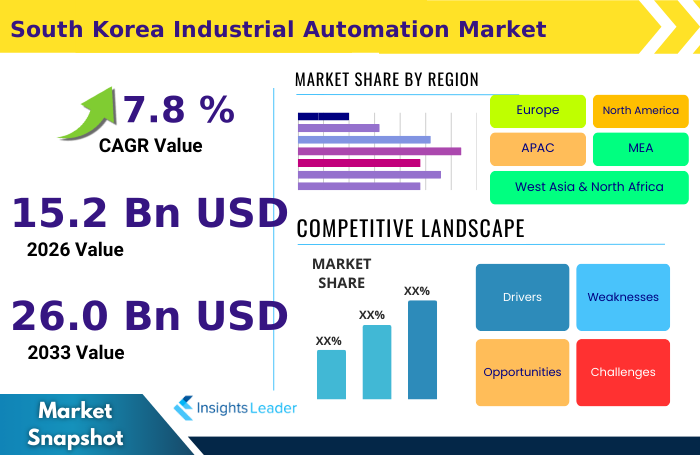
The South Korea Industrial Automation Market Size in 2026 is estimated to be USD 15.2 Billion
What is the Growth Rate (CAGR) of South Korea Industrial Automation Market?
The South Korea Industrial Automation Market is expected to grow at 7.8% CAGR
What is the Market Size of the South Korea Industrial Automation in 2033?
The South Korea Industrial Automation Market Size in 2033 is estimated to be USD 26.0 Billion
Report Snapshot
| Report Attributes | Report Details |
|---|---|
| Forecast Year | 2033 |
| CAGR | 7.8% |
| History Year | 2016-2024 |
| Market Size in 2026 | USD 15.2 Billion |
| Market Size in 2033 | USD 26.0 Billion |
What are DRO & Impact Forces of South Korea Industrial Automation Market?
The primary driver is aggressive government policy supporting ‘Smart Factory’ initiatives and digital transformation across key manufacturing sectors (electronics, automotive). Restraints include the high initial capital expenditure and complexity of integrating legacy systems with new Industry 4.0 standards. Opportunities lie in expanding automation into small and medium-sized enterprises (SMEs) and specialized sectors such as logistics and pharmaceuticals.
What is Impact of US Tariffs on South Korea Industrial Automation Market?
U.S. tariffs primarily induce supply chain re-configuration, encouraging South Korean firms to localize component production or diversify sourcing away from affected regions. This shift stabilizes domestic industrial automation suppliers but potentially increases short-term cost volatility for specialized imported technologies. The overall impact emphasizes resilience and domestic technological self-sufficiency in critical industrial components.
How is AI currently impacting South Korea Industrial Automation Market?
AI is fundamentally transforming operational efficiency by enabling advanced predictive maintenance protocols and sophisticated, real-time quality control systems. Machine learning algorithms optimize production scheduling and energy consumption, leading to significant reductions in downtime and operational waste. This integration supports the nation’s transition toward highly autonomous and data-driven manufacturing environments.
South Korea Industrial Automation Market Research Report – Table of Contents
1. Executive Summary
2. Introduction & Research Objectives
3. Scope of the Study
4. Research Methodology of South Korea Industrial Automation Market
5. South Korea Industrial Automation Market Overview & Industry Background
6. South Korea Industrial Automation Market Size & Forecast Analysis
7. South Korea Industrial Automation Market Segmentation Analysis
8. Competitive Landscape
9. Consumer Behavior & Demand Analysis
10. Pricing & Cost Structure Analysis
11. South Korea Industrial Automation Market Drivers, Challenges & Risks
12. Regulatory & Policy Framework
13. Technology & Innovation Impact
14. Strategic Insights & Recommendations
15. Conclusion & Future Outlook
For more queries, kindly contact [email protected]