Asia-Pacific Bionic Quadruped Robots Market Size and Insights – 2026 to 2033
Report ID : IL_18174 | Report Language's : En/Jp/Fr/De | Publisher : IL |
Format : 


What is the Market Size of the Asia-Pacific Bionic Quadruped Robots in 2026?
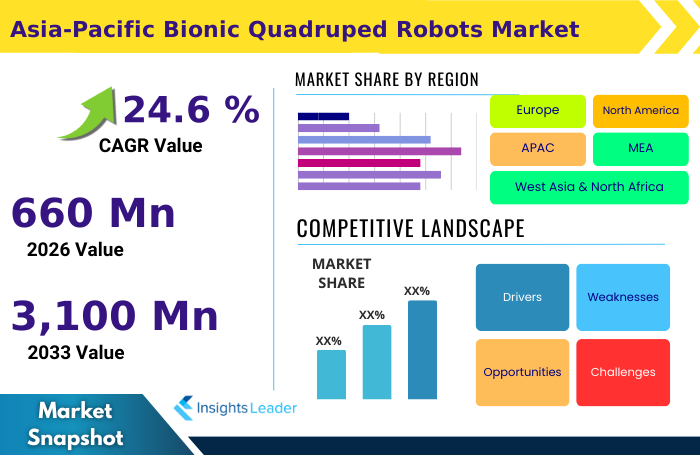
The Asia-Pacific Bionic Quadruped Robots Market Size in 2026 is estimated to be $660 Million
What is the Growth Rate (CAGR) of Asia-Pacific Bionic Quadruped Robots Market?
The Asia-Pacific Bionic Quadruped Robots Market is expected to grow at 24.6% CAGR
What is the Market Size of the Asia-Pacific Bionic Quadruped Robots in 2033?
The Asia-Pacific Bionic Quadruped Robots Market Size in 2033 is estimated to be $3,100 Million
Report Snapshot
| Report Attributes | Report Details |
|---|---|
| Forecast Year | 2033 |
| CAGR | 24.6% |
| History Year | 2016-2024 |
| Market Size in 2026 | 660 Million USD |
| Market Size in 2033 | 3,100 Million USD |
What are DRO and Impact Forces of Asia-Pacific Bionic Quadruped Robots Market?
Drivers include rising adoption in industrial inspection, last-mile logistics, and rapid infrastructure monitoring across major APAC economies like China, Japan, and South Korea. Opportunities are robust in disaster relief and security applications where human access is challenging. Restraints primarily involve high initial acquisition costs and the need for specialized technical expertise for maintenance and deployment.
What is Impact of U.S. Tariffs on Asia-Pacific Bionic Quadruped Robots Market?
U.S. tariffs on technology and components originating from specific APAC nations, particularly China, necessitate diversification of supply chains for key robot actuators and sensor systems. This accelerates the trend of manufacturing localization within APAC (e.g., Vietnam, India), mitigating tariff risks and fostering regional component self-sufficiency. This pressure contributes to fragmented regional pricing strategies but ultimately encourages deeper regional technological collaboration.
How is AI currently impacting Asia-Pacific Bionic Quadruped Robots Market?
Artificial Intelligence is foundational to modern quadruped functionality, enabling real-time environmental perception, autonomous navigation in unstructured environments, and advanced dynamic stability control. AI-driven algorithms allow these robots to perform complex tasks such as learning optimal gaits on diverse terrains and collaborative mission execution, significantly enhancing their operational efficiency and adaptability across various commercial sectors.
Asia-Pacific Bionic Quadruped Robots Market Research Report – Table of Contents
1. Executive Summary
2. Introduction & Research Objectives
3. Scope of the Study
4. Research Methodology of Asia-Pacific Bionic Quadruped Robots Market
5. Asia-Pacific Bionic Quadruped Robots Market Overview & Industry Background
6. Asia-Pacific Bionic Quadruped Robots Market Size & Forecast Analysis
7. Asia-Pacific Bionic Quadruped Robots Market Segmentation Analysis
8. Competitive Landscape
9. Consumer Behavior & Demand Analysis
10. Pricing & Cost Structure Analysis
11. Asia-Pacific Bionic Quadruped Robots Market Drivers, Challenges & Risks
12. Regulatory & Policy Framework
13. Technology & Innovation Impact
14. Strategic Insights & Recommendations
15. Conclusion & Future Outlook
For more queries, kindly contact [email protected]